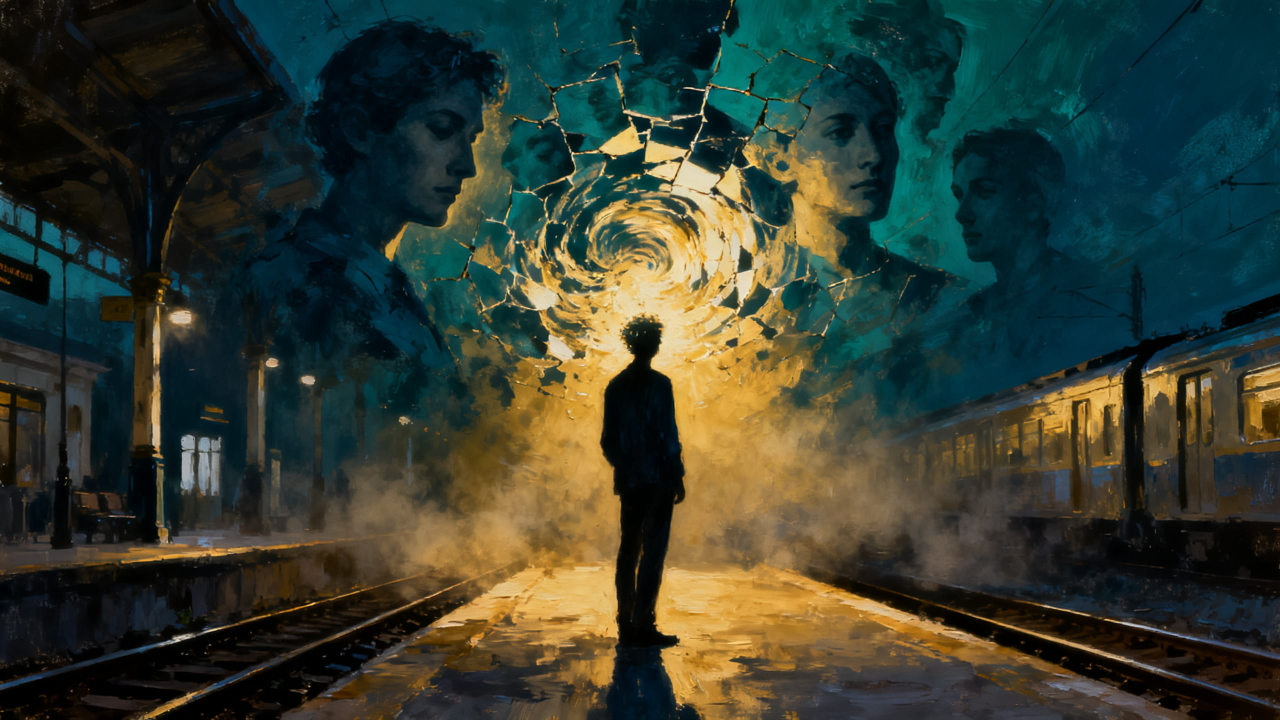
Schizophrenia Spectrum Disorders
Understanding Abnormal Behavior, 12th Edition · Sue, Sue, Sue & Sue · Cengage Learning, 2022 · Chapter 12 · Clinical textbook
Read this with your eyes open.
A man sat across from his doctor and said he was dead. The doctor asked him: dead men do not bleed, do they. The man agreed. The doctor pricked his finger and showed him the blood. The man looked at it and said — dead men do bleed after all.
That is not a parable. That is a case study. Walkup, 1995. It is printed in a textbook used to train clinicians, and the man in it could not be argued out of the grave by his own blood.
What this document is
This is not a religious book. It is not prophetic. It was written by four secular psychologists, peer-reviewed, footnoted, and sold to universities to certify the people who will one day decide whether you are well. It does not believe in spirits. It does not believe in prophets. It believes in dopamine and synaptic pruning and the multipath model.
That is what makes it worth reading. Because it wrote the voices down anyway.
What the textbook documents
The most common hallucination in schizophrenia is not something seen. It is something heard. A voice. The textbook records that the voices are most distressing when they are dominant and insulting — when they command.
It documents people convinced that their thoughts are being broadcast where others can hear them. People convinced that thoughts are being inserted into their minds. People convinced that thoughts are being pulled out. Control. Persecution. A voice that is not theirs, moving inside the place they thought was theirs alone.
It documents when this arrives. Late adolescence. Most symptoms appear by age eighteen. The textbook records that a gene called C4 switches on in those same years to begin pruning the brain, and that the disorder seems to ride in on that process.
It documents the channel. The textbook names cocaine, amphetamines, alcohol, and — its word — especially cannabis as raising the risk. It records that cannabis alters the neurotransmission pathways of the brain, particularly the adolescent brain. It records that drugs which move dopamine can manufacture full psychosis in a person who never had it. The substance opens something. The textbook calls it risk. It does not ask what comes through.
The textbook is honest enough to print the disagreement. In its own table of explanatory models, drawn from McCabe and Priebe, it records how four groups explain this illness. A share of every group named outside the Western clinic reads it as the supernatural — West African highest at nearly thirty percent, African Caribbean and Bangladeshi behind them. The one column that sits at zero is the Anglo West. Not a majority anywhere. But everywhere except the clinic, some portion of people looked at this and named it the spirit realm, and only the Western mind ruled that reading out entirely.
What Scripture told us was coming
The most common symptom is a voice. Scripture does not treat a voice as a malfunction. It treats it as a question to be answered.
“Beloved, do not believe every spirit, but test the spirits, whether they are of God.”
Test. Not silence. Not medicate into nothing. Test — because some of the voices are not of God, and the command assumes there is a real one to mistake for them.
There was a man who lived among the tombs and could not be bound. The voice in him gave its own name. Legion, for we are many. He was naked, screaming, cutting himself with stones, and every diagnostic category in this textbook would have a box for him. Christ did not reach for a category. Christ spoke to what was speaking, and the man was found clothed and in his right mind.
“What is your name? And he answered, saying, My name is Legion; for we are many.”
The textbook says the voices arrive by eighteen. There was a child who heard his name called in the dark and ran to the old man’s bed, three times, before anyone understood that the voice was not in the house. He was a boy. Samuel. The voice was God, and the hearing of it was the beginning of a prophet.
And the man who knew he was dead. Look at him again. He could be shown his own living blood and still believe the grave had him. There is only one cure in Scripture for a man who is certain he is dead, and it is not argument. It is to look at the dead God and live. The serpent lifted on the pole. The Son of Man lifted up. You do not reason the dead out of death. You give them something to look at.
“And as Moses lifted up the serpent in the wilderness, even so must the Son of Man be lifted up.”
What they did with it instead
The textbook is honest about its own history. The early treatment was the prefrontal lobotomy. They went into the skull and cut until the person stopped. It records, plainly, that one in three patients does not benefit from the medications that replaced the knife.
So the voice is heard. And the response, for a century, was to make the hearer quiet by force, and then by chemistry, and a third of the time even that does not reach what is speaking. The rest of the world kept calling it the spirit realm. The clinic kept cutting and dosing. The voices kept coming on schedule, at eighteen, through the same door the drugs open.
Why this matters
You are not reading a tract. You are reading a clinical textbook that does not share a single one of these convictions, and it still recorded all of it — the voices, the inserted thoughts, the door that drugs open, the age it arrives, the dead man who could not be talked out of the grave, the cultures that never stopped naming it spiritual.
It wrote down the evidence and filed it under biology. Read it the other way. Read it with your Bible open to Mark 5. The signs are all around us.
“Schizophrenia Spectrum Disorders” — Chapter 12 of Understanding Abnormal Behavior (12th Edition), a clinical chapter covering the symptoms of psychosis, the diagnostic criteria, the etiology, and the standard treatments. It is a copyrighted Cengage textbook, not an open document, and it should be obtained through a library or a legitimate bookseller rather than copied.
Before You Download Anything — Read the Book
Everything in this archive is a fragment of one larger picture. The book is where the fragments come together. No account. No paywall. No conditions.
Start Reading FreeThe Unveiled Eye
Baroque eye emblems for the watchful soul
STICKERS FROM $1.64 · TEES, CASES & MORE
Shop the Collection →Related Reading


A ministry dedicated to opening blind eyes — read freely online, no account, no paywall.
“To open the blind eyes, to bring out the prisoners from the prison, and them that sit in darkness out of the prison house.”— Isaiah 42:7
Pages
Support the Ministry
Read the book free — no account, no paywall.
Read Free Now