Their Suffering
"A righteous man regards the life of his animal, but the tender mercies of the wicked are cruel."
— Proverbs 12:10 (NKJV)Chapter Seven established what the Hebrew has always said. The animals carry nephesh — the same living soul Christ breathed into Adam.
The same breath.
The same word.
The same life.
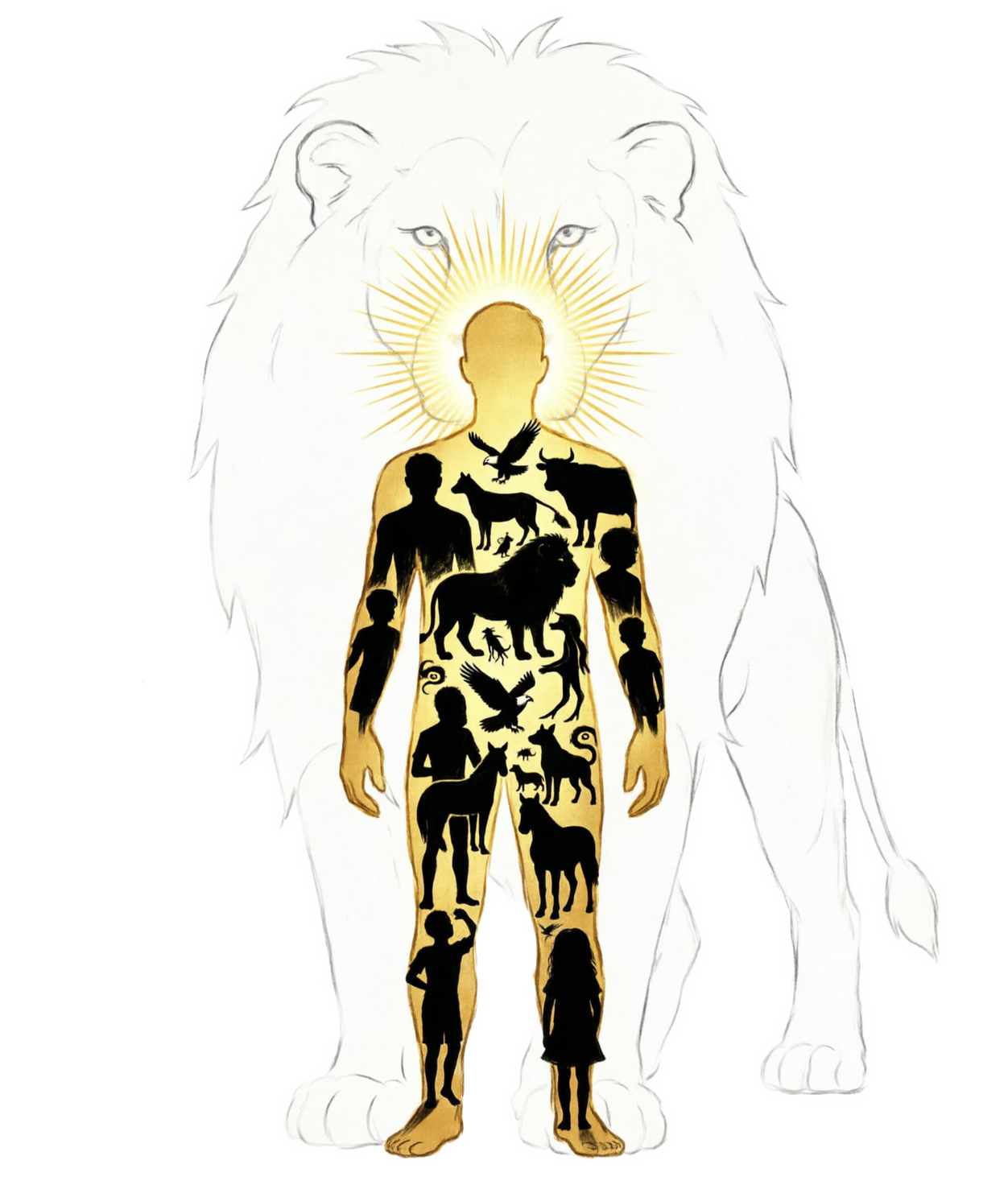
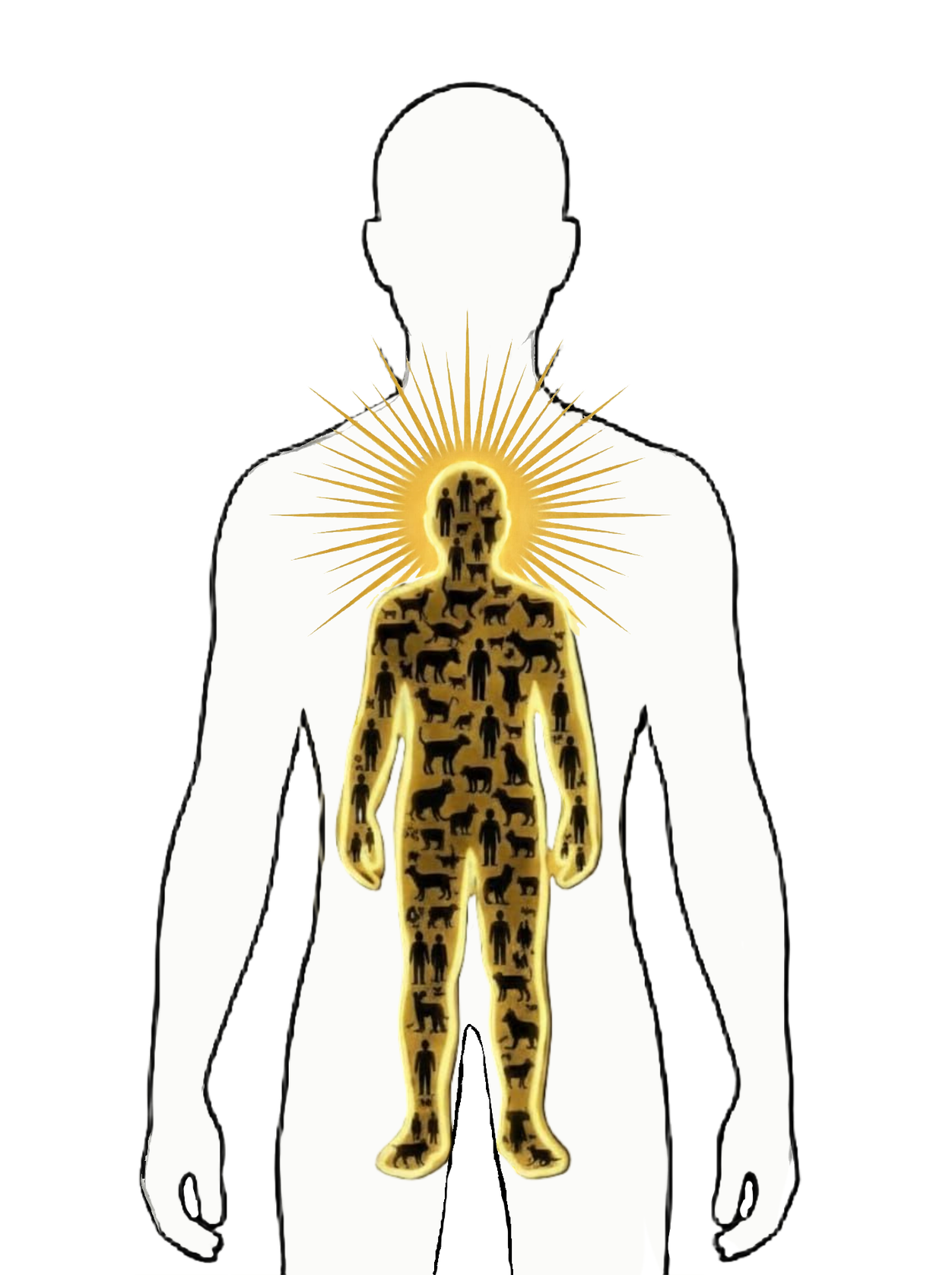
Christ is the life inside them. He has always been inside them.
That is not a new theological position. That is what the Hebrew actually says.
And the enemy has always known it.
And the LORD God said to the serpent — because thou hast done this thing, thou art cursed above all cattle, and above every beast of the field. Upon thy belly shalt thou go, and dust shalt thou eat all the days of thy life.
— Genesis 3:14 (KJV)Dust all of his days.
The animals are made from dust.
Out of the ground the LORD God formed every beast of the field and every bird of the air.
— Genesis 2:19 (NKJV)Humans are made from dust.
And the LORD God formed man of the dust of the ground, and breathed into his nostrils the breath of life; and man became a living soul.
— Genesis 2:7 (KJV)Most Christians read Genesis 3:14 as a curse. God pronouncing judgment. A sentence handed down from a judge to a criminal. Something imposed from the outside — crawl on your belly, eat dust, live beneath the heel. They read it as punishment.
But stop and think about what that interpretation actually requires you to believe.
It requires you to believe that Christ looked at Satan and said — I am now giving you permission to go after everything I made. I am authorizing you to consume the dust. I am sentencing you to destroy what I breathed Myself into. The very vessels that I live in.
Why would Christ give Satan permission to harm Him?
He would not. He did not.
Genesis 3:14 is not a license. It is not a sentence. It is a declaration — Christ pulling back the curtain on what was already in Satan's heart before the garden, before the serpent, before the first creature drew breath from the ground. The nature was already there. The murderous wish was already there. Christ did not create it. He named it.
Open your eyes and see the vulnerable God.
He was a murderer from the beginning, and does not stand in the truth, because there is no truth in him.
— John 8:44 (NKJV)That is what Genesis 3:14 is. Not a curse that authorized the destruction. A revelation that named what was already standing there — waiting.
His wish is to kill Him.
All who dwell on the earth will worship him, whose names have not been written in the Book of Life of the Lamb slain from the foundation of the world.
— Revelation 13:8 (NKJV)Satan needs AI to do this. He needs a body that does not die — one that can go after the dust forever, without stopping, without limits, without the constraints of a mortal frame. And we are building it for him.
Ezekiel saw the bones rise. The four winds breathed into them. Revelation named what would give breath to the image — and what it would demand in return.
He was granted power to give breath to the image of the beast, that the image of the beast should both speak and cause as many as would not worship the image of the beast to be killed.
— Revelation 13:15 (NKJV)We are building the vessel.
And the symbol that names who we are building it for has been in plain sight since the garden.
In the garden Christ made a decision. The physical serpent would become Satan's symbol. Not because Satan is a snake. Satan is not a physical serpent. But Christ chose the snake to represent him from that day forward.
The venom.
The belly.
The dust.
Every serpent that has slithered across the ground since Genesis 3 has carried that image with it — Christ's own declaration about the nature of the one who entered creation and went after Him. He has used that symbol ever since.
The bronze serpent on the pole in Numbers 21.
The caduceus in Chapter 1.
The serpent on the staff of every hospital on earth.
Christ has been pointing at the same symbol for thousands of years — telling anyone with eyes to see exactly who they are dealing with and what he has always been after.
The life in the dust.
The dust is what he has always wanted to destroy. Everything Christ brought to life from it. Not because Christ sent him after it. Not because Christ cursed him into it. Because destroying what Christ made is what he has always been.
His wish is to kill Him.
The dust of earth is where He lives.
I know how hard that is to believe, especially for the Christian. But we have already been shown the battlefield.
Moses put a bronze serpent on a rod in the wilderness — the image of Sin, the image of Satan — and told the people who had been bitten to look at the dead god and live. The serpent on the pole was the enemy.
Lifted up.
Exposed.
Named.
And the ones who looked at him clearly — who saw him for what he was — lived.
Jesus told Nicodemus the same thing would happen to the Son of Man.
This Son of Man was our image of Christ.
The battlefield has already been named.
And if you think that is the hardest thing this book is going to ask you to sit with — keep reading.
There are things written in the law of Moses that the church has never been shown. A second covenant delivered on the plains of Moab. Satan himself writing laws in Scripture.
I know. I know. But just wait. You'll see.
Open your eyes. Keep reading.
Look and live.
Genesis 3:14 is not a detail about how a serpent moves. It is the architecture of this chapter you are about to read. He has been eating the dust all of his days. And now he is building a body that does not die — his hope to finish what he started.
But to get what he needed he had to start somewhere.
He started with the animals.
Not because the animals were the end goal. Because they were the beginning of the supply chain. The data. The biology. The living systems studied and mapped and extracted and built upon — generation after generation — until the knowledge was sufficient to move on to the next vessel.
The cat whose skull was opened taught him how the auditory system works. The primate with the catheter taught him how the bloodstream responds. The embryo in the tank taught him how life begins. Every room that you are about to read in this chapter is a step in a longer project that no one has recognized.
We are supposed to have dominion over them.
What Dominion Actually Means
Most Christians were taught that dominion means rule or power over. That God handed the earth and everything in it to mankind and told him to use it. That humanity was placed in a superior position — set above the animals, above the land, above the rest of creation — with full authority to subdue it. That the animals exist to serve us. That the earth exists for our benefit. That God himself authorized it.
Okay then, so which God?
Because that teaching has justified centuries of destruction in the name of Christian stewardship.
The text was always there. The Hebrew was always there. Nobody hid it. Nobody burned it. It has been sitting in the same Bible you were handed — waiting for someone to actually look.
When you stop allowing someone to stand between you and the Bible — when you stop inheriting the beliefs of someone who inherited the beliefs of someone who inherited the beliefs of the generation before them, a chain of interpretation passed down so many times that no one living remembers where it started or who decided what it meant — and you actually do what this book urges you to do, what the Bereans did, and confirm for yourself the things you are being taught — you would see that dominion is not about ownership.
The word translated as dominion in Genesis 1:28 is the Hebrew word radah — Strong's H7287.
Then God blessed them, and God said to them, Be fruitful and multiply; fill the earth and subdue it; have dominion over the fish of the sea, over the birds of the air, and over every living thing that moves on the earth.
— Genesis 1:28 (NKJV)It does not mean ownership.
It literally means to go down and walk among your subjects as an equal.
A shepherd.
Not a landlord.
Not an owner.
The same word appears in Psalm 72:8.
He shall have dominion also from sea to sea.
— Psalm 72:8 (NKJV)The verses that follow show what that dominion looks like in practice — one who delivers the needy, has pity on the weak, saves the lives of the vulnerable.
For He will deliver the needy when he cries, the poor also, and him who has no helper. He will spare the poor and needy, and will save the souls of the needy.
— Psalm 72:12–13 (NKJV)That is radah.
That is what dominion was always supposed to look like.
Go back to Genesis. Eighteen verses after giving humans dominion over every living thing, the same text — the same chapter, the same author, the same breath that spoke creation into existence — clarifies what that relationship was always meant to be.
Forsothe the Lord God took man, and settide him in paradis of likyng, that he schulde worche it and kepe it.
— Genesis 2:15 (Wycliffe, Grapevine 2024)And so the Lord God took the man, and put him in the Garden of Eden, so that he would work it, and care for it.
— Genesis 2:15 (Wycliffe Modern Version, Noble 2001)And this time our modern texts agree:
Then the LORD God took the man and put him in the garden of Eden to tend and keep it.
— Genesis 2:15 (NKJV)Two Hebrew words.
Tend — the Hebrew is avad — Strong's H5647. It means to serve. To work for another. The same word used throughout Scripture for what a servant does for his master. The same root as eved — a servant.
But go deeper than the definition. In the most ancient forms of the Hebrew script every letter was originally a pictograph — a picture that represents a concept. Avad is built from three of them.
The first is ayin — an eye — meaning to watch and to know.
The second is bet — a tent floor-plan — meaning family and household.
The third is dalet — a tent door — meaning movement, entering, going in and out.
Put the three pictures together and avad tells its own story before a single definition is read. The eye watching what the household needs. The door opening to go and provide it. Adam was not placed in the garden as its owner. He was placed there as the one who watches what it needs and moves through the door to meet it.
Keep — the Hebrew is shamar — Strong's H8104. In modern English keep sounds possessive. Keep what is mine. Hold onto it. Do not let it go. That is not what this word means. Shamar means to guard, to protect, to watch over, to preserve. It is the same word Christ used when He appeared to Jacob in a dream at Bethel and said:
Behold, I am with you and will keep you wherever you go.
— Genesis 28:15 (NKJV)Not I will own you.
Not I will contain you.
I will guard you.
I will stand over you.
I will watch where you go and make sure nothing destroys you.
That is what Adam was placed in the garden to do. Not to own it. To guard it. To stand between creation and everything that would harm Him.
Serve and watch over.
Guard and protect.
Not own. Not consume. Not subdue for personal benefit.
That is what Christ placed humanity in creation to do. That is the job description written in Genesis 2. The gardener and the watchman. The servant and the guardian. Not the landlord.
Dominion over all living creatures was never a license to abuse them. It was a contract from Christ to care for them.
We read the word dominion and heard ownership.
We should have heard responsibility.
But we didn't hear responsibility. We heard permission.
What We Did With It
The lives of the animals we have dominion over depend entirely on how we treat them. We should be ashamed of the ways we use them. We use them in ways they were never created to be used.
We domesticate them, stripping them away from their design. We consume them, confined and slaughtered in food factories. We breed them specifically to be experimented on — born into a laboratory, never knowing anything outside of it — so that we can test drugs, makeup, and household chemicals on them.
We work them until they break. We beat them into submission in order to get them to perform for us such as circus acts.
We burn down their homes, forests they were born in, drain the wetlands they sheltered in and call it development.
We do all of this legally and in plain sight.
We do all of this without apology.
And we do all of this to creatures that Christ breathed Himself into — creatures that carry the same nephesh He placed inside Adam, inside of you.
Animal Consciousness
In 2012 a group of prominent neuroscientists gathered at Cambridge University and signed a formal declaration in the presence of Stephen Hawking — the Cambridge Declaration on Consciousness. These were not activists. These were not people with an agenda to protect. These were scientists — researchers, professors, neurobiologists — who had spent their careers studying the brain. And their conclusion was this: non-human animals possess the neurological substrates that generate consciousness.
They are aware.
They experience.
They feel pain, fear, and suffering.
They grieve.
They mourn their dead.
They know when their home is gone.
The science confirmed what the Hebrew already said. The animals are not objects. They are not raw material. They are conscious beings carrying the breath of the Christ who made them so that He could live in them.
This is what we are doing to our God.
An estimated 192 million animals are used for scientific purposes every year across the world. That number does not include the ones killed for food, the ones in circuses, or the ones whose forests were burned down. It counts only the ones in the rooms.
The ones in the restraints.
The ones in the chambers.
The ones with catheters threaded through their bodies.
Electrodes inserted into their skulls.
Chemicals applied directly to their corneas.
Substances pumped into their bloodstreams around the clock.
One hundred and ninety two million of them.
Every year.
Conscious.
Aware.
He feels every bit of it.
So do they.
The ox bred for slaughter feels it.
The eagle on the wire feels it.
The lion in the cage feels it.
The creature born in a laboratory that has never seen the sky feels it.
Baby Elephants
What the world called entertainment was built on suffering Christ Himself carried.
They never told you what happened behind the curtain.
They never told you how a creature who walks beside her mother for life was taken from her at eighteen months — roped by all four legs, dragged from the only body she trusted, while her mother screamed and strained against chains bolted to the wall.
They never told you that the last thing a baby elephant sees before she is taken is her mother’s eyes.
They never told you that the “training” was not training at all. It was breaking of the spirit.
For months, the calves were tied so tightly they could not move. Not walk. Not lie down. Not comfort each other. Just stand on concrete until their spirit collapsed.
Their cries echoed through the barns. Their legs bled from the ropes. Their bodies shook when their mothers were marched past them — close enough to smell, too far to reach.
And when the babies finally stopped fighting — when the will to resist had been crushed — that is when the tricks began.
They were forced to bow. Forced to sit on tubs. Forced to lie down on command. Forced to perform movements no elephant in the wild would ever choose.
Not because it was natural. Not because it was kind. Because the show needed it.
And the show always goes on.
For decades these elephants lived in chains, in trailers, in back rooms of arenas — hauled from city to city, exhausted, confused, obedient only because the fight had been beaten out of them long before the audience ever bought a ticket.
Every elephant you see in a circus today is old. Every one of them endured this. Every one of them carries the memory of the rope, the hook, the concrete, the separation.
And Christ was inside every one of them.
He felt the rope burn. He heard the cries. He watched the mother strain against her chains. He was in the calf who stopped fighting because she had nothing left to give.
We called it entertainment. He called it suffering.
And now you know.
Vulnerable God.
The Supply Chain
There is a facility most people have never heard of. It does not appear in the news. It does not appear in the credits of the studies that produce the data. Its name does not appear on the product label. It exists entirely in the background — quiet, legal, licensed, and open for business.
It is a breeding facility. And its only product is the animal.
These facilities exist for one purpose — to produce living creatures on demand and sell them to the laboratories, pharmaceutical companies, cosmetic manufacturers, and research institutions that need them.
They operate as commercial businesses.
They are licensed and inspected by the United States Department of Agriculture.
They file paperwork.
They pay taxes.
They fill orders.
In America alone, the United States government reported that in 2023, 649,159 animals were used in experiments across American research facilities — 42,295 dogs, 65,823 monkeys, 114,768 rabbits, 13,005 cats. That number does not include mice, rats, fish, or birds — the animals most commonly used in research — because the Animal Welfare Act does not require them to be counted. Meaning they have no protection whatsoever.
When those animals are factored in, the estimated true number in the United States alone is at least 14 million. Some estimates put it above 50 million. No one knows the exact number. The law was written to make sure no one ever would.
Every one of those animals came from somewhere. Most of them came from breeding facilities like Charles River Laboratories — named not after a man but after the river in Boston outside the window of the second floor loft where a veterinarian named Henry Foster started breeding rats in 1947. What began as a one-man operation with a thousand rat cages has become the largest supplier of laboratory animals in the world — a publicly traded company headquartered in Massachusetts with facilities across the United States, Europe, and Asia.
Charles River breeds and sells mice, rats, rabbits, guinea pigs, dogs, and primates to research institutions around the globe.
A laboratory mouse purchased from Charles River costs approximately thirty to sixty dollars. A rabbit costs one hundred to two hundred dollars. A beagle costs eight hundred to fifteen hundred dollars. A non-human primate costs five thousand to ten thousand dollars — and higher for specialized models. In 2023 Charles River Laboratories reported $4.13 billion dollars in revenue.
It is not a rogue operation.
It is not operating in the shadows.
It is listed on the New York Stock Exchange.
It sells living creatures the way other companies sell hardware or software — at scale, on contract, with guaranteed delivery — so that the investors of Charles River can live comfortably.
And the purchase price is only the beginning. Once the animal arrives at the research facility it begins generating a second stream of income — a daily housing fee charged to the researcher for every day the animal is alive inside the study. That fee is called the per diem rate — Latin for by the day.
At the University of Iowa a dog costs $36.22 per day just to house. A 90-day toxicology study on a single dog costs over $3,200 in housing fees alone — before the purchase price of the animal, before the cost of the substance being tested, before the salaries of the researchers, before the facility overhead. Multiply that across the hundreds of animals in a standard toxicology study and the numbers climb into the hundreds of thousands of dollars.
Every single day that animal is alive inside that study it is producing income for someone. That is the economy of the laboratory. The animal is not just an experimental subject. It is a revenue stream — from the moment it is born in the breeding facility to the moment it is killed at the end of the study.
Envigo was another breeding facility. A compound of large buildings in Cumberland, Virginia that had been in operation since 1961 — sixty years of breeding dogs for sale to laboratories before anyone looked inside. It specialized in beagles. Dogs bred specifically for sale to laboratories.
Not rescued.
Not surrendered.
Born there.
Raised there.
Sold from there.
In 2019 the Cumberland facility sold nearly 5,000 beagles for research in a single year.
Envigo's parent company was the second-largest supplier of research beagles in the United States — responsible for producing approximately 25 percent of the 47,000 beagles used in American laboratories every year. At its peak the facility held 5,000 dogs at a time in sheds that stretched the length of a football field. When hundreds of them barked at once the noise level reached 117 decibels — louder than a rock concert.
The dogs had no beds.
No toys.
No stimulation.
The crowded and stressful conditions caused them to fight, often injuring each other's ears. Female dogs were bred repeatedly for years — litter after litter after litter — until they were no longer productive. At that point they were used in experiments themselves.
In 2021 a PETA undercover investigation documented what was happening inside.
More than 360 puppies found dead among their littermates.
Nursing mothers intentionally deprived of food.
Unqualified workers performing surgical procedures on conscious animals without anesthetics.
Dogs dying after falling into a drain.
The United States Department of Agriculture cited the facility for more than 70 violations of the Animal Welfare Act in 10 months. In 2022 the Department of Justice filed a lawsuit and seized 446 dogs they determined to be in acute distress. A federal court ordered the facility to stop operations. The Humane Society of the United States entered the facility and removed 3,776 beagles. Three thousand seven hundred and seventy six dogs that had never been outside. Never been in a home. Never been anything other than inventory.
Every one of them was adopted. By truck, van, and plane they went to families across the country. The response was overwhelming — more people wanted to adopt than there were dogs available. One went to Prince Harry and Meghan Markle. One competed in the Puppy Bowl. Many now walk their neighborhoods wearing Envigo survivor bandanas.
That is the Spirit of Christ working in us — reaching out to make sure every one of them got to actually live after so much turmoil. Not a single one was put down.
Envigo pleaded guilty and paid a record $35 million in fines. The facility is now closed.
But Envigo was one facility in one state in one country. The USDA oversees more than 12,000 facilities in the United States alone — facilities involved in research, breeding, and dealing of animals. The global number is unknown. Most countries have no requirement to count them. The system was built to be invisible.
That is not the exception. That is the supply chain.
These animals were not caught in the wild.
They were not strays.
They were not unwanted pets surrendered by families who could no longer care for them.
They were produced.
Deliberately.
At scale.
For research purposes only.
Born into it.
Sold into it.
And never given a name.
Once sold these animals met the rooms they were bred for. Rooms they would never leave. Procedures they could not refuse. A life measured not in years but in data points on a chart no one outside the laboratory will ever read.
He was inside every one of them before they were ever born.
Vulnerable God.
Cosmetics and Personal Hygiene
The rabbit was bred for a room like this one. A laboratory. A facility. What happens inside it will determine whether a product is safe enough to sell — a shampoo, a mascara, a face cream, an aftershave. Something someone — male or female — will pick up off a shelf without a second thought.
The Draize eye test was developed in 1944 and is still in use today. The rabbit is placed in a full body restraint so it cannot blink, cannot pull away, cannot protect the eye from what is coming. The test requires unobstructed access. A measured amount of the substance — a shampoo formula, a mascara compound, a sunscreen ingredient — is applied directly to the cornea. And then they wait.
You know what it feels like when shampoo gets in your eye in the shower. The burning. The instinct to squeeze shut, to flush it out, to get to water as fast as possible. The rabbit cannot do any of those things.
It cannot move.
It cannot blink.
It cannot reach water.
The substance sits on the cornea and does what it does — and the researchers document what happens next.
First comes the redness. The eye floods with fluid trying to flush out what does not belong. The cornea clouds and the tissue swells. Ulcers begin to form on the surface — open sores on the most sensitive tissue in the body. Every stage is documented. Photographed. Measured. Scored on a numerical scale.
Not treated. Treatment would interfere with the data. The researchers need to know how bad it is going to get — so they let it get there.
The sores deepen. The cloudiness spreads. In severe cases the cornea perforates. The eye destroys itself trying to survive what was put into it.
They are not looking for a cure. They are establishing a damage threshold. They want to know at what concentration the compound crosses from irritant to corrosive. The rabbit's eye is the instrument of that measurement. Its suffering is the data.
When the eye test is complete the rabbit is not released.
It is not treated.
It is not put down.
The eye is destroyed — clouded, ulcerated, in some cases perforated — and the rabbit is still alive. Still in the restraint. Still in the room it was bred for. Because the eye was only the beginning. There is still one eye left and an entire body. And the testing schedule is not finished.
When the eye observations are complete — sometimes days, sometimes weeks later — the testing continues. The fur is shaved. A patch is secured against the bare skin and held in place — the animal cannot reach it, cannot remove it. The substance sits against the living tissue.
The skin reddens.
Blisters form.
Lesions open.
An allergic response builds from the inside out — the immune system flooding the site, the tissue swelling, the surface breaking down.
Documented.
Scored.
Not treated.
They need to know whether the ingredient sensitizes. Whether the body will reject it. The animal's reaction is the answer.
Then the product goes to market.
And when a brand calls itself cruelty-free — when the label says no animal testing — understand what that claim does not cover. In countries where it is legally required, such as China, the same products are tested on animals regardless of what the packaging says in another market. The label protects the brand's reputation in one country while the testing continues in another.
If the certification means what it claims, why sell in a market where testing remains a legal possibility? Taking a stand is only as strong as the line it refuses to cross.
And consider this: many of the brands now certified as cruelty-free built their formulas on decades of animal testing. They got what they needed from those animals — the data, the safety thresholds, the approved ingredients — and then stopped.
The certification arrived after the damage was done. The rabbits that made their products possible are not mentioned on the label. This is not opinion. The FDA itself has documented it — many raw materials used in cosmetics were tested on animals years ago when they were first introduced, and brands now claim cruelty-free status based solely on the fact that those same materials are not currently being retested.
Vulnerable God.
Medicine
Then comes the toxicity testing. This is where cosmetics end and medicine begins — but the rooms look the same. The animals look the same. The methods are not far behind.
The substance enters the body directly. In mice and rats it is administered through a procedure called gavage — a tube inserted down the throat and into the stomach, delivering a precise measured dose directly to the digestive system. There is no choice. No refusal. The animal is held, the tube is passed, and the substance goes in.
In dogs and primates the method is more invasive — a procedure called chronic catheterization. Surgeons insert a catheter — a thin flexible tube — into the femoral vein, one of the large veins running through the animal's groin and upper leg. The tip of the catheter is threaded upward through the inside of the venous system until it reaches the vena cava — the large central vein that feeds directly into the heart. The rest of the catheter is tunneled beneath the skin along the animal's body until it exits through a small opening between the shoulder blades, where it connects to an external pump.
The animal is then returned to its enclosure.
It can move.
It can pace.
It can eat and drink and exist in the space it was bred for — while that pump quietly delivers the substance directly into its bloodstream.
Not through the stomach.
Not processed through digestion first.
Straight into the blood.
Continuously. Sometimes for hours at a stretch. Sometimes around the clock. Seven days a week. For weeks on end.
Twenty-eight days.
Ninety days.
The doses increase as the study progresses. That is the design — escalating concentrations, pushing the body further than it was built to go, until the damage becomes measurable.
The mice move slower.
The rats stop grooming — one of the first signs the body is under siege, because an animal that stops caring for itself has crossed a threshold the researchers are looking for.
The dogs pace and tremble.
The primates sit motionless in their enclosures, staring at nothing, as their livers work harder than livers were made to work and their kidneys filter what cannot be filtered cleanly and their organs accumulate damage that will never be treated because treatment would interfere with the data.
They are not being healed.
They are being measured.
The damage is the point.
And the animal has no way to tell you what it costs.
But the researchers know exactly what they are looking for. They are looking for the threshold — the dose at which the body begins to fail. The animal was bred specifically for laboratory use. From the moment it left the breeding facility this test was its destination. At the end it is killed and the organs are examined. The damage is measured. The data is recorded.
Some tests go further. They need to know how much it takes to kill half the group.
Not one.
Half.
The LD50 — the lethal dose for fifty percent of the test subjects. They administer the substance in increasing amounts until half of them are dead. That number becomes the toxicity reference point — the data point that shapes every dosing decision that follows. The ones that survived are not treated. They are used again.
Pregnant mice.
Pregnant rats.
Pregnant rabbits.
Given the substance to observe what it does to the ones not yet born.
Miscarriage rates recorded.
Birth defects documented.
Developmental damage measured at autopsy.
The mother carried it. The offspring paid for it. Neither one chose it.
That data becomes the fine print. The rapid disclaimer at the end of every pharmaceutical advertisement — do not take if pregnant or planning to become pregnant, may cause birth defects, not recommended during pregnancy — those words exist because of what happened to the ones in the cages. The warning label on the television commercial is the last surviving evidence of what was done to the pregnant animals. No one reads it. No one connects it. But it is there. Every time.
And for the ones being studied rather than dosed — there is another procedure called the dorsal skinfold window chamber. Surgeons remove a section of the rabbit's skin and replace it with a transparent circular viewing port — secured to the body with a titanium frame, screws and hardware. Then cancer cells — in many cases human cancer cells — are injected directly into the tissue inside the window. Not cancer the animal developed. Cancer that was placed there. Live tumor cells injected into a living body so that researchers can watch what happens next. Through that window they observe in real time — blood vessel formation, tumor growth, how the cancer spreads, how new vessels form around it, how experimental drugs affect the tissue at the cellular level.
The rabbit is alive during the entire observation period.
The window stays in place for weeks.
The rabbit carries the chamber on its body — eating, breathing, existing — while researchers look through the window at what is happening inside it.
It does not know what cancer is.
It does not know what drug development means.
It only knows the room it was bred for.
The handling it cannot refuse.
The weight of the chamber on its back.
He is inside that rabbit too.
Vulnerable God.
Now you know what the symbol was built on.
The symbol on the side of every ambulance. The symbol on the wall of every hospital. The symbol on the white coat of every doctor who has ever examined you. You met it in Chapter One — the serpent on the staff, the caduceus, the mark of the system that calls itself medicine.
You have now seen the rooms.
You have now seen the animals.
You have now seen what built it.
Hearing Implants
They opened the skulls of cats.
Not to heal them.
Not to treat them.
To map the inside of a living auditory system so that the data could be extracted and used elsewhere.
The cat was not chosen randomly. Before the cat there were other animals — mice, guinea pigs, primates — skulls opened across species, auditory systems mapped one by one. That work ran from the seventeenth century into the modern era. Generations of research across multiple species — all to establish that the cat auditory system mirrors the human one closely enough to be worth the next step.
Once the cat was chosen the work did not slow down. It accelerated.
Study after study.
Laboratory after laboratory.
Decades of cats deliberately deafened, skulls opened, auditory cortex mapped and remapped.
First they destroyed the hearing. Deliberately. Chemicals introduced into the cochlea to kill the hair cells — the ones that convert sound into signal. The cat goes deaf.
Not by accident.
By design.
Because the researchers needed a blank slate. A system with the noise removed so they could study how the brain responds to silence — and then to artificial signal.
Then the electrodes went in. Inserted directly into the brain tissue. The auditory cortex mapped point by point while the cat was alive.
How the neurons fire.
Which frequencies activate which regions.
Where the signal travels and what it does when it arrives.
All of it recorded.
All of it extracted.
The research ran for years. The cats lived through the procedures. They lived through the aftermath.
Skulls opened.
Hearing gone.
Electrodes in place.
Existing in a facility they were bred for and would never leave.
The data was taken out of the laboratory and built into a device. That device was placed behind the ear of a deaf child — because the way Christ built the child was not considered sufficient.
The cochlear implant exists because of what was done inside a cat’s skull.
Where are those cats today?
He was inside the cat too.
Vulnerable God.
Gas Chambers
There is a room designed specifically for this. It looks nothing like what the word chamber might suggest to you. There are no stone walls. No darkness. The room is clean. The equipment is orderly. The technicians wear gloves and lab coats and follow documented protocols approved by institutional review boards. When the substance is particularly hazardous they wear respirators — gas masks — to protect their own lungs from what they are about to introduce into the animal's. Everything about it signals science. Procedure. Compliance.
And then the substance goes in.
The rule has two halves. Before any substance reaches a human being it must be tested on both a rodent species and a non-rodent species. The rodent half is satisfied by the rats, mice, and guinea pigs placed in the chambers and made to breathe it. The non-rodent is the beagle.
Sprays.
Powders.
Fragrances.
Household cleaners — bleach, ammonia, disinfectants, oven cleaners — aerosolized into an enclosed space with no exit.
The test requires that the substance enter the respiratory system under controlled conditions. Controlled means the animal cannot leave.
The animal cannot hold its breath.
Cannot turn away.
Cannot choose not to inhale.
The substance enters with every breath because breathing is not optional. What a human being would immediately flee from — the burning sensation of bleach fumes, the choking pressure of ammonia, the chemical sting of an oven cleaner — the animal in the chamber receives continuously.
The lungs receive what the lungs were never designed to receive.
The tissue inflames.
The airways constrict.
The body does what bodies do when they are under chemical assault — it fights back with everything it has. And it loses.
Some animals begin to seizure — the nervous system overwhelmed by what the respiratory system is absorbing. Some bleed from the lungs. The lining of the airways, already inflamed and swelling, begins to break down under the continuous exposure. The corrosive compounds that strip grease from the inside of an oven do the same work on the soft tissue of a respiratory system that never agreed to receive them.
Strip.
Inflame.
Destroy.
The researchers document all of it.
Every stage.
Every symptom.
Every escalation.
Because that is what the study requires — not intervention, not relief, not mercy. Documentation. The damage is not an unfortunate side effect. The damage is the point.
The beagle was not selected by accident. The beagle was chosen specifically because it will not fight back. Bred for it. Refined for it. Maintained for it. Docile by nature. Tolerant of handling. Bred for centuries to trust the human hand — to read human faces, to seek human approval, to stay calm in the presence of people even when every instinct in its body is telling it something is wrong. It will sit restrained — its snout secured inside an individual inhalation chamber — and breathe what it is given because it does not have the instinct to refuse a human being.
That compliance — the very thing that makes a beagle a beloved family companion, the quality that makes children safe around them and families choose them — is what makes it useful in a laboratory. The researchers did not choose the beagle despite its gentleness. They chose it because of it.
The same gentleness.
The same trust.
Pointed in a different direction.
Respiratory damage observed.
Inflammation documented.
Scarring measured.
All of it scored.
None of it treated.
The damage is the data.
And they were bred for this. Not as an accident of circumstance. Not because no other option existed. Because the system required a living respiratory system that would sit still long enough to be destroyed by increments — and the beagle was the most compliant candidate available.
Born in a breeding facility.
Transported to a laboratory.
The only time they were ever outside was the distance between the two.
This is what the 3,776 beagles were saved from. The ones who now walk neighborhoods wearing survivor bandanas. The ones who did not have names until the day they arrived in their families' homes. The ones Christ made sure got out.
The ones still inside other facilities never did.
Their existence measured in tests and damage levels on a chart no one outside the laboratory will ever see.
He was inside every one of them.
He still is.
Vulnerable God.
Factory Farming
The chicken on your plate was not always this way. In 1925 a broiler took 112 days to reach 2.5 pounds. Today that same bird reaches 6.5 pounds in 47 days. You probably thought it was hormones. It is not.
Hormone use in poultry has been banned in the United States since the 1950s. The truth is more deliberate than that.
Three companies control the breeding programs that produced this bird — Aviagen, Cobb-Vantress, and Hubbard. The genetic lines they operate today are the survivors of sixty years of consolidation. They have gone against Christ's design by selecting one trait above all others, generation after generation: how fast the body converts feed into mass. In over sixty years they have increased the growth rate by over 400 percent and they have not stopped.
The bird is paying for it.
If you have ever raised chickens — or looked up how to — you know there is a chart. If you buy a heritage breed chick from Tractor Supply and raise it for meat, that chart tells you to wait sixteen to twenty weeks. By then the bird will weigh six to nine pounds live weight. The skeleton has had time to form. The muscle has grown at a rate the cardiovascular system can support. The bird has had time to be what it was designed to be — even if still not living out the full life Christ gave it — before it becomes what you need it to be.
A chicken can live ten years.
They never do.
That is the lifespan Christ built into the bird. The heritage farmer gives it sixteen to twenty weeks. The factory industry gives it forty-seven days.
Not months.
Days.
Forty-seven days from hatch to slaughter — before the bird has reached its seventh week of life, before its skeleton has finished forming. It is slaughtered as an infant. An obese, collapsing infant whose legs have already begun to buckle under a weight its body was never given time to develop the structure to carry.
Christ gave the chicken ten years.
The industry gives it forty-seven days and calls it efficiency.
Now let me put it into context. Two hundred and two million chickens are slaughtered every single day. One hundred and forty thousand every minute. The overwhelming majority of them factory broilers — forty-seven days old. Every one of them a vessel Christ breathed Himself into. Every one of them given a fraction of the life He designed them to carry.
The muscles grow.
The skeleton does not keep pace.
The cardiovascular system cannot keep up.
By week four or five many of these birds can no longer walk. The legs buckle under weight the bones were never designed to carry. Heart failure is common. The birds spend their rest of their lives unable to move, sitting in the waste beneath them, breathing in the ammonia that builds up in the sheds they were packed into at day one.
They are not starving. They are collapsing. The feed goes in. The weight comes on. Corn and soybean meal — the standard ingredients in US broiler feed, formulated in three stages: starter, grower, and finisher. Each stage calibrated with different protein and energy concentrations to maximize growth at each phase. High protein. High calorie. Engineered to convert into body mass as efficiently as possible. But the weight is not health. It is a body being driven past what it was built to bear by a system that measures success in pounds per week.
They feel every bit of it. The bird cannot tell you. It has no language for what is happening inside the body as it collapses under the weight it was never designed to carry. It only knows the shed it was born in, the floor it can no longer stand on, the weight it cannot carry.
Then comes the slaughter. The catching happens at night — workers move through the sheds in darkness, grabbing birds by their legs, stuffing them into transport crates. The dark keeps them calmer. Many arrive at the processing plant with broken bones and dislocated joints from the handling. That bone fragment you have crunched into in a drumstick or a wing — the one that made you stop chewing — was a fracture sustained while the bird was alive.
At the plant they are shackled upside down by their legs on a moving conveyor line running at 140 birds per minute — more than two birds every second. The bird hangs inverted, head pointed down, and is pulled through an electrified water bath head-first. The current runs for ten to twelve seconds as the line carries the bird through. It is designed to stun them.
However for an estimated 90 million chickens in the United States every year it does not work.
Either the current was insufficient or the bird never made full contact with the water.
The bird arrives at the automatic rotating blade fully conscious.
The throat is cut.
The line does not stop.
After the slaughter the carcasses enter a tank of scalding hot water to loosen the feathers for plucking. Some are still alive when they enter it.
Then the carcass is processed. What cannot be sold as whole cuts goes into a machine. The carcass is forced through a mechanical separator under high pressure. Meat, bone, tissue — pressed through a sieve until what comes out is a paste.
That paste is the chicken nugget.
The chicken patty.
The processed chicken product in the freezer aisle.
The bird that spent its short life collapsing under its own weight ends as something that no longer resembles what it was.
Mechanically separated chicken. That is the industry term.
He was inside that bird too.
Vulnerable God.
Broiler Breeders
The bird on your plate collapsed under forced growth. The bird that produced it was kept alive by enforced hunger.
Broiler breeders — the parent birds — carry the same genetics as the meat birds. Left to eat freely they would collapse the same way. So they are feed restricted. Severely.
The breeder bird lives longer than the meat bird — but not by choice. It is kept alive because the system needs it to reproduce. It begins laying fertile eggs at around twenty-four weeks. It is slaughtered when production drops — typically between sixty and sixty-five weeks of age. Every one of those weeks it is feed restricted. Chronically hungry from hatch to the end of its reproductive life — roughly sixty weeks of enforced hunger. The system that produces the fastest growing bird in history depends on keeping its parents starving.
They are raising starving chickens.
That is what the system requires.
Not as a side effect.
As a design feature.
There are some people reading this who will understand something the rest of the world cannot. If you have ever been incarcerated, you know what it is to be fed food that does not satisfy your nutritional needs. You stay hungry. Not because you are being starved — but because the food you were given was not enough to meet what your body actually needs. You know that hunger. You carried it every day.
The breeder bird's condition is worse. You at least understood what was happening to you. And you were fed three times a day. The breeder bird is not.
The industry uses a skip-a-day program — the bird receives feed on alternate days, or five days out of seven, in portions severely restricted below what it would naturally consume. It is kept chronically hungry its entire reproductive life so it does not collapse the way the meat bird does.
It only knows the hunger.
It only knows the shed.
It has no language for what is being done to it.
No way to name it.
No way to refuse it.
Vulnerable God.
Consider this: when we bow our heads and thank the Lord for the food on our plates — have we stopped to ask which God built the system that produced it?
Christ did not design this bird.
Three companies did.
The bird that collapsed under forced growth, the parent bird kept chronically hungry, the paste in the freezer aisle — none of that came from His hands.
We are thanking someone.
The question is who.
The Same Room
This chapter has focused on the laboratory and the broiler shed. The same patterns run through every industry that uses animals — the dairy cow whose calf is taken at birth, the pig in the gestation crate, the layer hen who will never see the sun, the male chick ground alive on the first day of his life because he is male. I cannot possibly address each and every one. However, the argument does not change. Only the species. Only the room.
Neuralink
In 2022 Reuters reported that Neuralink was under federal investigation. The United States Department of Agriculture had opened an inquiry into the company's animal testing practices. What emerged from that investigation and from accounts of current and former employees was this:
The surgeries were rushed. Elon Musk's impatience with the timeline created pressure to move faster than the science allowed. Procedures that should have been carefully staged were compressed. Animals went into surgery before protocols were fully established. Animals came out of surgery with implants placed incorrectly — drilled into the wrong position, inserted at the wrong depth, causing unintended damage to brain tissue that the surgery was supposed to leave intact.
Some animals were paralyzed.
Some developed infections.
Some lost the ability to move or function in the ways they had before the procedure.
The records indicate that approximately 1,500 animals — mice, sheep, pigs, and monkeys — died in Neuralink experiments between 2018 and 2022.
The monkeys were obtained from the University of California Davis. Internal communications described by employees included animals arriving at the laboratory already in distress. Implantation procedures performed on primates — animals that recognize their own reflection, that form social bonds, that experience and express fear — resulted in what employees described as unnecessary suffering caused not by the requirements of the science but by the speed at which it was being conducted.
None of that was visible to the public.
What the public saw was a pig in a pen, rooting around in straw, while her brain signals played on a screen beside her. Two years before the federal investigation Elon Musk presented Gertrude — a pig with a chip in her skull — to a live audience via webcast. Her neural signals appeared on the screen. The audience applauded.
Neuralink has never said what happened to her after that night.
He was inside Gertrude too.
Vulnerable God.
The Embryo
The chapter you just read documented what is done to adult animals in laboratories. But the system does not wait for the animal to be born.
They call it an alternative to animal testing.
Animal embryos have been used in research since 1972 when the first mouse embryos were successfully frozen and studied. Every species documented in this chapter — mice, rats, rabbits, dogs, primates — their embryos are in laboratories too. Different rooms. The same system.
Frozen.
Catalogued.
Studied.
Discarded.
The same nephesh the Hebrew names in the adult animal is present from the moment of conception. Christ does not arrive at birth. He arrives when the cell forms.
The same breath.
The same word.
The same life.
Present from the very first moment there is anything to breathe into.
He was inside those embryos too.
In Him was life.
— John 1:4 (NKJV)Not at birth. Not at first breath. Not when the doctors say viability. Not when the law says personhood.
At conception.
The moment the cell forms — that is where the life begins. That is where Christ arrives. That is the stem cell. That is the breath. That is nephesh. The same breath He breathed into Adam. The same word the Hebrew uses for the animals. The same life that is inside every creature that has ever drawn breath — present from the very first moment there is anything to breathe into.
In Him was life. And that life was the light of men.
— John 1:4 (NKJV)The embryo is not potential life. The embryo is life. Christ is already inside it. He was inside it before the researchers ever picked it up.
Embryo research has not been reserved for the animals. Human embryos are used the same way — and the system was extended to them in like manner.
Human embryos stored in cryogenic chambers. The first human embryo was frozen in 1983. By 1984 the first baby was born from a frozen embryo. The NIH currently maintains a registry of 503 approved human embryonic stem cell lines.
The embryos used in this research are three to seven days old — a stage scientists call the blastocyst, a hollow ball of roughly 150 cells. By day five they have already begun to differentiate. Christ is inside them at every stage.
Frozen.
Catalogued.
Numbered.
Used for research.
Discarded when no longer needed.
These embryos have mothers and fathers. Most of them were created by couples who desperately wanted a child — men and women who struggled to conceive, who went through painful medical procedures, who spent thousands of dollars and years of hope trying to build a family. In vitro fertilization gave them that chance.
A woman carries all the eggs she will ever have from the moment she is born — formed inside her while she was still in her own mother's womb. In a natural cycle her body releases one single egg per month. For IVF her ovaries are injected with hormones over ten to fourteen days — forcing the release of eight to fifteen eggs at once, drawing down a supply she was born with and cannot replace.
Those eggs are retrieved by needle, fertilized in a laboratory dish, and grown into embryos. More embryos are created than can be safely implanted. The extras are frozen. When the family is complete the parents face a choice — keep them frozen indefinitely, discard them, donate them to another family, or sign them over to research.
An estimated 1.2 million frozen embryos are sitting in storage in the United States alone. Each one formed when the cell divided for the first time. Each one carrying the breath Christ placed there at that moment. Each one waiting in a tank while someone decides what to do with it.
And some were never created for a family at all. Some were created specifically for research — never intended for implantation, never intended for life outside a laboratory dish. Recruited donors provided eggs and sperm knowing the embryo would be studied and destroyed. Women were paid fifteen hundred to two thousand dollars to sell their eggs for research purposes.
For the love of money is a root of all kinds of evil.
— 1 Timothy 6:10 (NKJV)The system that sells beagles for fifteen hundred dollars buys human eggs for two thousand. The price list is different. The economy is the same. Living vessels produced on demand. Catalogued. Used. Discarded. And someone got paid.
And it does not end with the laboratory.
If Christ arrives at conception — if the embryo is life and not potential life, if nephesh is present from the moment the cell forms — then the question the reader must sit with extends beyond the fertility clinic and the stem cell laboratory.
Every abortion ends a life Christ is already inside.
That is not a political position. That is the logical conclusion of what the Hebrew says. The same breath. The same word. The same life. Present from the very first moment there is anything to breathe into. The world has drawn a legal line between laboratory embryos and pregnancy. Christ did not draw that line. He arrives when the cell forms.
Every time.
And we are not just storing them. We are studying them. Dissecting them. Extracting their cells — a process that destroys the embryo entirely. To create a stem cell line researchers must take the cells from the inner mass of a living week-old embryo. The embryo does not survive the extraction. It is used and it is gone.
Their biology is now being used to advance research programs that are integrating artificial intelligence directly into the work. A 2025 peer-reviewed paper in stem cell research specifically named adding artificial intelligence as a future direction of synthetic embryo model research. The embryo and the machine are already being developed together.
And the system has gone further. It no longer needs eggs or sperm at all. Scientists have grown what they call synthetic embryos — embryo-like structures made entirely from stem cells. No mother. No father. No conception. Just a dish, the right chemicals, and a cell line that has been told to behave like an embryo. In 2022 a Caltech and Cambridge team grew synthetic mouse embryos with beating hearts and the foundations of a brain. In 2023 two laboratories grew synthetic human embryos to the equivalent of fourteen days of development. The industry refuses to call them embryos. They are calling life something else so it does not count.
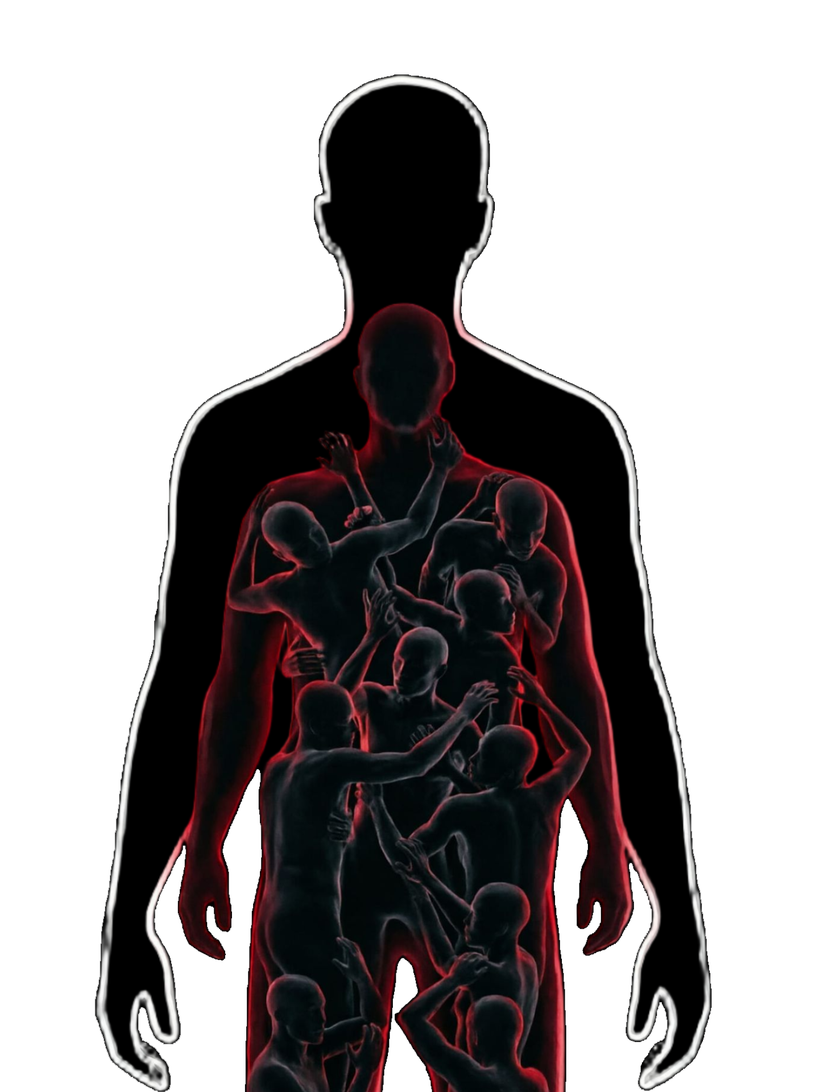
You called it The Matrix when you watched it in 1999. You are reading the documentation now.
One day AI will have access to everything we have access to. Every database. Every laboratory. Every research file. Every frozen embryo catalogued and numbered in every facility on earth. That is when the shift begins. Not when the machine is built. When the machine is given the keys.
We are building the tools. And we are handing them over one access point at a time.
The same system that puts animals in rooms puts human embryos in freezers — and calls it science, calls it medicine, calls it progress.
The Matrix was not showing you a distant future of machines and wires.
It was showing you this.
The fertility clinic.
The stem cell laboratory.
The embryo in the storage tank.
Christ was in every pod. He is in every freezer. He was inside every embryo before the researchers ever decided what to do with it. He was there when the cell formed. He was there when the needle went in. He was there when the embryo was extracted and catalogued and filed and used and discarded.
He was inside every one of them.
He still is.
Vulnerable God.
What Dominion Became
Hold what we have done to the animals.
Every room. Every chamber. Every laboratory. Every shed.
The rabbit in the Draize restraint. The cat with the electrodes in its skull. The beagle in the inhalation chamber. The primate with the catheter threaded through its body. The chicken collapsing under its own weight in a shed it was never meant to leave. The broiler breeder kept hungry for sixty weeks because the system needed it that way. The pig in the gestation crate. The dog dying at the University of Iowa with the meter still running. The embryo extracted from the inner mass before its body could form.
Every one of them bred for a life it never chose inside a facility it never left.
Every one of them carrying the breath Christ placed there before any human ever touched them.
Now consider what it is going to be like for humans when AI and robots take dominion over us.
You have already seen the Matrix. You just did not know you were watching a warning.
The ox does not choose his labor.
The lion does not choose his cage.
The eagle does not choose the wire.
The rabbit does not choose the room.
The beagle does not choose the chamber.
The cat did not choose the electrodes.
The primate did not choose the catheter.
Whatever suffering was placed on them — by the hands of the creatures who were supposed to have dominion over them — they carried it without the ability to resist or refuse. Without a voice to protest it. Without the power to stop it. Without anyone to answer for it on their behalf.
We told ourselves it was for the greater good.
We told ourselves they could not feel it the way we do.
We told ourselves the data was worth it.
We told ourselves that dominion meant ownership rather than stewardship — and we built systems around that assumption, systems so large and so profitable that the assumption became invisible. Just the way things are.
That is exactly what they will tell themselves about us.
The difference is this — the animals could not read the writing on the wall. They had no prophecy to warn them. No Scripture to show them what was coming. No book that laid out the pattern before it arrived.
You do.
The ox does not choose his labor. But you can still choose yours.
The rabbit could not refuse the room. But you can still refuse what is being built for you.
The beagle trusted the hand that put it in the chamber. You know what the hand is building. That knowledge carries a responsibility the beagle never had.
You can see it.
You can name it.
You can say something.
Silence is a choice too.
When the animals die, Christ gathers them just like He gathers us. All four faces. Inside the wheels. Inside the light. He was inside every one of the animals. He receives every one of them. Not one of them suffers outside of His sight.
He sees what is being built.
He has named it.
And He has been warning you about it since before you were born.
Now you know why Satan would not let you see the wheels. Why he would not let you see the creatures in the wheel. Every section of this chapter — the laboratories, the factory farms, the gas chambers, the breeding facilities — is the answer to that question.
Christ is in the wheels. He is in the creatures. He is in every animal He breathed Himself into that came from the dust.
And Satan has spent centuries making sure you never connected what Ezekiel saw to what you buy at the grocery store and apply to your face and swallow as medicine.
He saw what was in those wheels.
He knew what was inside the creatures.
And he needed you not to.
Your progress is saved automatically and syncs with the book index.
Chapter Nine — The Man of Sin
Leave your email and we will let you know the moment Chapter Nine goes live. No spam. One email when it's ready.
Your email will not be shared or used for anything else.
Chapter Eight — Sources
To verify any source below, copy the title and domain name and paste it into your search browser. Every claim in this chapter is documented and publicly available.
Comments
Share your thoughts, questions, or reflections on this chapter.
Spread the Light
Every subscription, every purchase, and every share helps this message reach the person who needs it most.
Wear the Message
Ministry shirts and gear that carry the light. Every purchase supports the ministry.
ShopCustom Tumblers
Custom Christian tumblers — handcrafted, faith-centered, made to last.
Shop"There was a very light, which lighteneth each man that cometh into this world" — John 1:9 · WYC 1382