Though Thou Hast Not Known Me
"For in him we live, and move, and have our being."
— Acts 17:28 (KJV)The fact-checkers saw the predictions the same way you have. They spent hours cataloguing the evidence — compiling lists, comparing dates, analyzing images frame by frame.
Their conclusion: coincidence. They found the fingerprints and decided nobody left them.
That is not stupidity. That is exactly what Jesus said would happen.
By hearing ye shall hear, and shall not understand; and seeing ye shall see, and shall not perceive.
— Matthew 13:14 (KJV)They did the research. They found the pattern. They just had no framework for what they were actually looking at. They stopped at human hands when the trail leads somewhere else entirely.
The conspiracy theorists looked too. They said the elite were revealing their plans through entertainment — predictive programming — conditioning the masses to accept what was coming.
They got closer. They understood something was being communicated.
But they stopped at shadowy rooms full of human hands when the answer points somewhere outside of time altogether.
There is a third explanation. One that everyone — even Christians — overlooks entirely.
Christ Is The One Doing It
Our Creator — who exists outside of time, who knows the end from the beginning, who declares things before they happen — is speaking through the very people who do not even know they are being used.
I am God, and there is none like me, declaring the end from the beginning, and from ancient times the things that are not yet done.
— Isaiah 46:9–10 (KJV)Think about it. Creativity is a gift from the Creator.
Where does imagination come from? Where does the ability to envision things that do not yet exist originate? Where does the capacity to create art, write stories, compose music, and design worlds that have never been seen — where does that come from?
It comes from Him.
Them hath he filled with wisdom of heart, to work all manner of work, of the engraver, and of the cunning workman, and of the embroiderer, in blue, and in purple, in scarlet, and in fine linen, and of the weaver, even of them that do any work, and of those that devise cunning work.
— Exodus 35:35 (KJV)Remember the wheels? The Spirit was in the wheels — and the wheels moved. The Spirit is in the mind, in consciousness — and the mind creates. That is why Paul told us to have the mind of Christ.
Let this mind be in you which was also in Christ Jesus.
— Philippians 2:5 (NKJV)Jesus had the mind of Christ. Fully. We can too.
But we have the mind of Christ.
— 1 Corinthians 2:16 (NKJV)Having the mind of Christ is not a metaphor.
For some it is agreement — a will yielding to the One who has been inside them since they were being formed in their mother’s womb.
For thou haddist in possessioun my reines; thou tokist me vp fro the wombe of my modir.
— Psalm 139:13 (Wycliffe, Grapevine 2024)For thou hadst in possession my reins; thou tookest me up from the womb of my mother.
— Psalm 139:13 (Wycliffe Modern Version, Noble 2001)For others it is movement without awareness. The vessel fulfills a purpose it never chose and never understood. The Spirit does not always wait for permission. He moves through whoever He selects — whoever is in the position He needs them to be in, in order to act.
A film director whose work will be seen by millions.
A car designer who puts wings and wheels on his vehicles, and sells them by the thousands.
For in Him we live and move and have our being.
— Acts 17:28 (NKJV)He is real.
He is present.
He still speaks.
He can be heard.
He can be felt.
He can be known — not as a concept, not as a doctrine, but as a presence that lives inside you, moving, and working.
We create because we are made in the image of a Creator God.
So God created man in His own image; in the image of God He created him; male and female He created them.
— Genesis 1:27 (NKJV)Our creativity is a reflection of His creativity. Our imagination is derived from His infinite imagination. Every artist, writer, filmmaker, and designer operates with a capacity that ultimately comes from Him — whether they acknowledge it or not. Whether they believe in Him or not.
He Gives Breath and Spirit to All
Now look again at Isaiah 42:5:
Thus says God the Lord, Who created the heavens and stretched them out, Who spread forth the earth and that which comes from it, Who gives breath to the people on it, and spirit to those who walk on it.
— Isaiah 42:5 (NKJV)Read that carefully.
Christ gives breath to the people. Christ gives spirit to those who walk on the earth.
Not some of them.
Not just the ones who pray.
Not just the ones who go to church or carry a Bible or know His name.
All of them.
Animals included.
That breath.
That spirit.
That is where creativity comes from.
That is where imagination comes from.
That is where the ability to envision things that have not yet happened originates.
Every human being walking this earth has been given breath and spirit by Christ Himself — whether they acknowledge Him or not.
The atheist filmmaker?
Christ gave him breath. Christ gave him spirit.
The secular novelist?
Christ gave her breath. Christ gave her spirit.
The agnostic game designer?
Christ gave him breath. Christ gave him spirit.
Christ declares the end from the beginning. He moves through human hands and human minds to deliver warnings before the disasters arrive.
He does not need the vessel’s permission.
He does not need the vessel’s belief.
What He needs is the vessel to be in the right place.
Whoever is in the place where Christ sees an advantage — that person is used and driven by the Creator. Because the Creator lives in all people.
The filmmaker does not have to know he’s being used.
Cyrus didn’t.
And if that isn’t enough — Christ speaking through Jesus said that when you give water to “the least of these,” you are giving water to Him.
I was a stranger and you did not take Me in, naked and you did not clothe Me, sick and in prison and you did not visit Me. Then they also will answer Him, saying, “Lord, when did we see You hungry or thirsty or a stranger or naked or sick or in prison, and did not minister to You?” Then He will answer them, saying, “Assuredly, I say to you, inasmuch as you did not do it to one of the least of these, you did not do it to Me.”
— Matthew 25:43-45 (NKJV)“The least of these.”
The church has preached this verse for two thousand years. And they have not been wrong.
The hungry.
The thirsty.
The stranger.
The naked.
The sick.
The prisoner.
Christ is in every one of them.
When you feed someone who is starving, you are feeding Christ.
When you visit someone in prison, you are visiting Christ.
When you clothe someone who has nothing, you are clothing Christ.
That is true.
That is real.
That is the gospel.
But ask the church how it is true, and here is what they will tell you: that Christ identifies with the poor. That He takes it personally when you serve them — counts it as if it were done to Him. That the hungry man stands in for Christ, and the kindness you show him is credited to Christ’s account. Christ represented in the person. Christ standing behind them, receiving what you give.
That is what they believe.
But it does not go far enough.
How are you feeding Him when you feed the hungry?
This is the part Christians do not take all the way to its end — and I cannot grasp how they miss it, when they are the ones reading and teaching the Bible every day.
How? How can handing a sandwich to a stranger be handing it to Christ Himself?
It has been a while since I reminded you, but remember Legion? The one who spoke in Mark 5 was not the man — it was Legion, fully occupying him, speaking through his mouth. And here stands the same architecture, turned to the good: Jesus, fully indwelt by Christ, and it is Christ who speaks through him.
So hear what He is telling us from inside of human flesh.
He is not watching the hungry person from the sky somewhere, pleased that you brought them a meal.
He is not standing beside them, nodding His approval as the food enters their mouth.
He is not somewhere else, taking note of your good deed and crediting it to your account.
He is inside the hungry person, inside of you, inside of Jesus.
Literally.
That is where He lives.
The bread you put in that person’s hand is the bread that goes into a body Christ is living inside.
The water you give the thirsty person fills a throat Christ is breathing through.
The blanket you wrap around the cold one wraps a body Christ is sheltering inside of.
The visit you make to the prisoner — Christ is in that cell.
You are not doing a kind thing for someone Christ approves of.
You are touching Christ Himself.
Every act of mercy is an act of mercy toward Him — not as a metaphor, not as a transaction, but as a literal encounter with the God who lives inside the vessels.
And if He is in the hungry — He is in every hungry person. Every single one. The grateful and the bitter, the clean and the filthy, the one who thanks you and the one who curses you.
If He is in the prisoner — He is in every prisoner. Even the drug addicts and sinners.
If He is in the stranger — He is in every stranger.
Not just the ones who speak your language or look like you or come from the country you come from.
The mainstream church has taught the first half of this verse, but the second half is what this chapter is asking you to see.
Christ is in the pagan king who never worshipped Him.
Christ is in the atheist filmmaker who has never set foot in a church.
Christ is in the secular novelist who would call you a fool for believing.
Christ is in the agnostic game designer who built the deck without knowing whose hand was on his.
Christ is in the person you wrote off because they did not believe what you believe.
The person you stopped praying for because they had been gone too long.
The person you decided was a lost cause.
The person you crossed the street to avoid.
The person whose name you don’t even remember anymore.
Christ is in them.
Every one of them.
Because the Creator lives in everything that is alive.
He isn’t watching from a distance. He is present in every person and animal walking this earth.
That is how close He is to the vessel.
And that is not what you have been taught.
The Word Nobody Translated
Cyrus — a pagan Persian king, a man who by Christ’s own admission had never known Him — was prophesied by name a hundred and fifty years before he was born.
For Jacob My servant’s sake, and Israel My elect, I have even called you by your name; I have named you, though you have not known Me.
— Isaiah 45:4 (NKJV)The scholars could not accept it. A prophecy that precise — a man named by name, a century and a half before his birth — violated everything they believed about what was possible. So they came up with a theory. The Deutero-Isaiah theory, which held that a second, anonymous author wrote chapters forty through sixty-six of Isaiah after Cyrus was already on the scene.
That resolved the timing problem for them. It also buried something theologically inconvenient, then and now. Christ calling a pagan king His anointed. A word reserved for the kings of Israel, for the priests, for Jesus the Messiah himself.
The skeptic says Isaiah must have been written after Cyrus — history disguised as prophecy. But look at the dates they assign it themselves. Their own critical dating runs to 539 BC at the latest. Cyrus took Babylon that year. He did not issue the decree that freed the captives and ordered the temple rebuilt until the year after.
And the temple was already in the text before he issued it.
Who says of Cyrus, “He is My shepherd, and he shall perform all My pleasure,” saying to Jerusalem, “You shall be built,” and to the temple, “Your foundation shall be laid.”
— Isaiah 44:28 (NKJV)Thus says the Lord to His anointed, to Cyrus.
— Isaiah 45:1 (NKJV)A hundred and fifty years before this man drew his first breath — before his parents met, before Persia rose — Christ spoke his name through Isaiah’s mouth. Called him shepherd. Called him anointed. Named what he would build before he was born to build it.
Cyrus was a king. And that is what He needed — the man in the right position to accomplish what He required. So He anointed him. Just like the filmmakers whose films get in front of the eyes of millions.
The Hebrew word for anointed is māšîaḥ — Strong’s H4899. The KJV translates it “anointed” thirty-seven times and “Messiah” twice. Same word.
And Strong’s own entry lists its uses across the same categories: the Messiah, the king of Israel, the high priest of Israel — and Cyrus. The same word, the same entry, Cyrus listed right alongside the Messiah.
Not a similar word. Not a related word. The identical word.
Daniel used that same word to describe the coming deliverer. Watch how the translators render it this time.
Know therefore and understand, that from the going forth of the command to restore and build Jerusalem until Messiah the Prince, there shall be seven weeks and sixty-two weeks.
— Daniel 9:25 (NKJV)Messiah — that is H4899. The promised one. The deliverer. The one the whole of Israel was waiting for. When Jesus arrived, his disciples recognized him by that same title.
Andrew ran to his brother and said:
We have found the Messiah (which is translated, the Christ).
— John 1:41 (NKJV)Watch what that verse does. Andrew says the Hebrew word — Messias, Strong’s G3323, which is māšîaḥ written in Greek letters. And John, writing for Greek readers, stops the sentence to translate it for them.
Which is translated, the Christ.
Christos. G5547.
One word, carried the whole way. The Hebrew that named Cyrus. The Hebrew Daniel used for the deliverer. And the Greek John set beside it, in Andrew’s own mouth.
Anointed, anointed, anointed — Cyrus to Daniel to Andrew, the same word every time.
Now look at where that Greek word came from.
Christos is from chriō, to anoint. But in ordinary Greek it meant something closer to oiled.
We already know what that looks like, because Scripture shows it to us. When Samuel went to Bethlehem to find the next king of Israel, he did not perform a ceremony or hand over a crown. He took a horn of oil and poured it over a shepherd boy’s head in front of his brothers.
Then Samuel took the horn of oil, and anointed him in the midst of his brethren: and the Spirit of the LORD came upon David from that day forward.
— 1 Samuel 16:13 (KJV)The Hebrew behind came upon is tsalach — H6743. Does it mean arrived? That is debatable. Strong’s gives it as break out. Come mightily. Push forward. The ESV renders it rushed upon him.
Here is the thing. Something only breaks out of what it was already inside.
The lexicons will not settle that for you. They give you the force and leave the direction open. But the pattern throughout the rest of Scripture does settle it. Christ is the life inside all men. So He was in the boy already, and what broke out that day was not His arrival. It was His driving.
And still, the boy was anointed with oil.
The Greeks used the same word, chriō, and they used it constantly — but not for kings. They used it for athletes. A wrestler was rubbed down with olive oil before he fought, and scraped clean afterward with a curved bronze tool called a strigil. The Greeks carved statues of it. They are called apoxyomenos, the scraper — a naked man bent forward, dragging the blade down his own forearm.
That is what Christos meant to a Greek ear. Not a throne. Not a temple. A man covered in oil.
Kings had nothing to do with it.
Then Jewish scholars in Alexandria sat down with the Hebrew scrolls and began translating them into Greek, about two hundred years before Jesus was born. When they came to māšîaḥ they reached for Christos.
And they used it on Cyrus.
The Greek Bible calls that pagan Persian king tō christō mou. My anointed. My Christ.
οὕτως λέγει κύριος ὁ θεὸς τῷ χριστῷ μου Κύρῳ
Thus says the Lord God to my anointed, Cyrus
— Isaiah 45:1 (Septuagint)Two centuries before there was a man from Nazareth.
Now, this book does give the name Christ to the Spirit who dwells in us. The One whose name is called the Word of God.
…and his name is called The Word of God.
— Revelation 19:13 (KJV)But Christ is not a name. It never really was. It is a condition.
And that is exactly why I use it as a name. I needed a way to separate the man from the One inside him, and the language does not give you one. There is Jesus, and there is what was in Jesus, and English has only ever handed us both of them stuck together in a single breath. Jesus Christ. A first name and a last name, as though they were one person.
They are not. So I took the word that describes the condition and gave it to the One who causes it.
To be anointed is not a title. It is not an honor bestowed in a ceremony. It is a description of what is happening inside the vessel. Anointed. Driven. Filled. The anointed one is the one Christ is actively driving — the one through whom He is working, the one in whom He is alive, present and moving.
The world combined the two into one. I am separating them. Taking off the lid so you can see.
And I am not the first to see them apart. Paul said it from inside the experience.
For to me, to live is Christ, and to die is gain.
— Philippians 1:21 (NKJV)Not to live for Christ. To live is Christ. The life operating inside him was Christ Himself.
And Paul knew he carried Him. When the Corinthians demanded he prove his authority, he did not point to himself. He pointed to the One inside him.
since you seek a proof of Christ speaking in me, who is not weak toward you, but mighty in you.
— 2 Corinthians 13:3 (NKJV)The same indwelling this whole book traces, named by Paul himself. The life in him was not his own. It was Christ — and that same Christ was mighty in them also, the people he wrote to. And mighty in you too.
Paul was in direct communication with the Spirit inside of him. We see this many times throughout his writing. When a thorn tormented him, he did not petition a distant God in the sky. He spoke to the One within him, and the One within answered.
For this thing I besought the Lord thrice, that it might depart from me. And He said unto me, “My grace is sufficient for thee: for my strength is made perfect in weakness.”
— 2 Corinthians 12:8–9 (KJV)He could speak to the Spirit living inside of him. He asked. The Spirit answered. A conversation — inside a man — between the vessel and the One who filled it.
And the Spirit did more than answer. He directed. He steered Paul’s steps, closing doors and opening others, city by city.
Now when they had gone through Phrygia and the region of Galatia, they were forbidden by the Holy Spirit to preach the word in Asia. After they had come to Mysia, they tried to go into Bithynia, but the Spirit did not permit them.
— Acts 16:6–7 (NKJV)Forbidden by the Spirit. Not permitted by the Spirit. This is not a man following a rulebook. This is a man being led, in real time, by the One living inside him.
And it can be done quietly, in the closet of your own mind.
But thou, when thou prayest, enter into thy closet, and when thou hast shut thy door, pray to thy Father which is in secret; and thy Father which seeth in secret shall reward thee openly.
— Matthew 6:6 (KJV)You do not have to say it out loud. You can think it, the way you would think a prayer.
He hears that. How?
Look at what the verse describes. A room with the door shut. Nobody else in it. A Father who is in secret and who sees in secret.
Jesus is telling them to go somewhere no one can watch, and speak to Someone already there.
And there is one more proof.
On the island of Malta, shipwrecked and gathering sticks for the fire, Paul was struck by a viper. It fastened on his hand and hung there.
And when Paul had gathered a bundle of sticks, and laid them on the fire, there came a viper out of the heat, and fastened on his hand… And he shook off the beast into the fire, and felt no harm. Howbeit they looked when he should have swollen, or fallen down dead suddenly: but after they had looked a great while, and saw no harm come to him, they changed their minds, and said that he was a god.
— Acts 28:3–6 (KJV)Everyone watching knew what came next. They had seen men die from bites like this. They waited for him to swell, to drop, to fall dead in the sand. By every natural law it should have killed him. But the venom did nothing. He shook the beast into the fire and felt no harm.
That was not luck, and it was not a harmless snake. Paul carried Christ. The Spirit alive within him left the poison powerless — proving Himself in the man He filled.
It ties back to the story in the wilderness. The men on Malta were not Hebrews. They did not know that story. But we do — and we were supposed to recognize it here.
Instead the church teaches this as a protection miracle. Christ guarding His messenger so he could reach Rome. Or it preaches it as a lesson in resilience — shake off the serpent, shake off your trials, keep going. Or it points to what came after: the islanders who watched him live went from calling him a murderer to calling him a god, and a door opened for the gospel on Malta.
All of that is in the account. None of it is the thing itself.
The power was not around Paul, shielding him from the outside. The power was inside him. Christ was alive in the vessel. It was not Christ protecting a man from a distance. It was Christ, present within him, leaving the poison with nothing to take.
And the people watching, who had no Scripture to name what they saw, still saw the truth with their own eyes. They did not understand what they were looking at. But they perceived it anyway — that there was something divine within him.
The Spirit answered him. The Spirit directed him. And when the venom came, the power of Christ in him was the antivenom.
Paul knew the One inside him — not as doctrine, but as the voice he spoke with, the hand that steered him, and the Life the venom could not take that day. It was fellowship with the Word. The same fellowship Moses had.
Forsothe the Lord spak to Moises face to face, as a man is wont to speke to his freend.
— Exodus 33:11 (Wycliffe, Grapevine 2024)Forsooth the Lord spake to Moses face to face, that is openly, as a man is wont to speak with his friend.
— Exodus 33:11 (Wycliffe Modern Version, Noble 2001)Face to face, as a friend. And then, a few lines later, this.
Thou canst not see my face: for there shall no man see me, and live.
— Exodus 33:20 (KJV)No man can see His face and live. So the face to face was never about a face. It was about nearness. It meant the Word was right there — as present, as close, as immediate as a friend speaking to you across a table. Moses did not see a face. He had the presence.
Moses had Him. Paul had Him. And between the two of them stands Jesus, who showed Him to us.
For he whom God hath sent speaketh the words of God: for God giveth not the Spirit by measure unto him.
— John 3:34 (KJV)Not by measure. The Spirit was not visiting Jesus. The Spirit was driving him. That is what made him the Messiah — not his bloodline, not his birth, not a ceremony performed over him. The active, driving presence of Christ inside him.
Christ Working Through Those Who Do Not Know Him
Now go back to the Persian.
That same word — māšîaḥ, H4899 — Isaiah placed directly in front of the name of a man not yet born. A king who would one day act on behalf of a God he never worshipped.
Which means Christ was actively working through Cyrus. The same way He worked through Moses, and Jesus, and Paul. Driving him. Moving through him toward a specific divine purpose.
And there was a clock running. Jeremiah had written to the exiles years before, telling them how long it would last.
For thus saith the LORD, That after seventy years be accomplished at Babylon I will visit you, and perform my good word toward you, in causing you to return to this place.
— Jeremiah 29:10 (KJV)I will visit you. The Hebrew is pāqad — H6485. Not a social call. It means to attend to, to oversee, to intervene. It is the word for someone with authority stepping in and doing something about a situation.
He says He will do it. He does not say what He will use.
And when the seventy years ran out, the ruach of Cyrus was stirred. Ruach is H7307 — the same word Scripture uses for the Spirit of God and for the breath in a man. There is only the one word. And the verb is ʿuwr, H5782. To rouse. To wake something that is already lying there.
Now in the first year of Cyrus king of Persia, that the word of the Lord by the mouth of Jeremiah might be fulfilled, the Lord stirred up the spirit of Cyrus king of Persia, so that he made a proclamation throughout all his kingdom, and also put it in writing.
— Ezra 1:1 (NKJV)Ezra is the one who connects them. Jeremiah gave the number, and Ezra tells you the number ran out on the day a Persian signed an order.
He said He would visit them. He did it from inside a Persian king.
In Ezra’s record of that decree, Cyrus credited the LORD of Israel for his kingdoms and for the commission to build the temple. But his own Persian records tell a different story. The Cyrus Cylinder — an ancient clay tablet discovered in 1879, now in the British Museum — credits the Babylonian god Marduk for his rise to power. Not the LORD. Marduk.
Same king. Two different gods. Two different audiences.
So which one did he actually believe? We can never know with certainty. Scripture records what he said to the Jews. Secular history records what he said to everyone else. I will be honest about that tension and not pretend it is not there.
But look closely at what the tension proves.
A man who genuinely knew the God of Israel does not go home and credit Marduk for the same victories. And a man who genuinely served Marduk does not hand the Jews a decree crediting the God of Israel for his empire. He did both, in writing, to two different rooms.
There is no way to know why. The man is twenty-five hundred years dead and he left two accounts that do not agree. Either way, he did not know Whose hand was on him.
And that is not a problem for what I am showing you. That is the whole point.
I have named you, though you have not known Me.
— Isaiah 45:4 (NKJV)Christ never claimed Cyrus knew Him. He claimed the opposite, a hundred and fifty years before the man drew breath. The not-knowing is not a gap in the record. It is in the prophecy.
And even where Cyrus did credit the God of Israel, watch what he did with it.
Thus saith Cyrus king of Persia, The LORD God of heaven hath given me all the kingdoms of the earth.
— Ezra 1:2 (KJV)There is only one who offers all the kingdoms of the earth, and it is not Christ.
Again, the devil took Him up on an exceedingly high mountain, and showed Him all the kingdoms of the world and their glory. And he said to Him, “All these things I will give You if You will fall down and worship me.”
— Matthew 4:8–9 (NKJV)That is Satan’s currency — all the kingdoms of the world. Jesus was offered the exact thing Cyrus claimed to have received, and he refused it, because he knew whose hand it came from.
Cyrus did not. He took the kingdoms of the earth from the god of this world and thanked the God of heaven for them, and never knew he had confused the two.
That is what it looks like not to know Christ. Not the absence of religion — Cyrus was religious. It is the inability to tell which god is which.
And Christ knew he never would. That was not a flaw in the plan. That was the plan. A man who could tell them apart would not have taken the kingdoms of the earth from the hand that offered them — the same hand Jesus refused in the wilderness. Cyrus had to be in that seat to sign that order, and getting into that seat required a man who did not know what he was being handed.
Because Christ was not after kingdoms. He was after the captives. Cyrus could keep the kingdoms. Christ took the prisoners.
Do not for a moment think Christ does not make these kinds of trades. There is a war going on in a realm we cannot see, and pieces are being moved on a board we cannot read. He has said so plainly.
For I am the LORD thy God, the Holy One of Israel, thy Saviour: I gave Egypt for thy ransom, Ethiopia and Seba for thee. Since thou wast precious in my sight, thou hast been honourable, and I have loved thee: therefore will I give men for thee, and people for thy life.
— Isaiah 43:3–4 (KJV)I will give men for thee. And people for thy life.
That is how He works. Nations handed over, in exchange for the ones He called. He does not hide the practice. He put it in writing.
And that was the whole of it. The ruach in Cyrus woke, and His people walked out of captivity — while the king thanked the wrong god for the wrong things the whole way through.
Because the mission was never about Cyrus. It was about the captives.
It started long before Cyrus. Long before Isaiah. It started in Egypt. Pharaoh feared the growing number of Israelites and issued a decree — every Hebrew boy born thrown into the Nile.
And whatsoever remaineth… every son that is born ye shall cast into the river.
— Exodus 1:22 (NKJV)But one boy was preserved inside Pharaoh’s own house, raised as Pharaoh’s own daughter’s son, educated in all the wisdom of Egypt. He was a murderer and a fugitive. And Christ sent him back to dismantle the entire system from the inside.
Let My people go.
— Exodus 5:1 (NKJV)Moses did not free Israel. Christ freed Israel through Moses. The vessel was flawed — he argued, he made excuses, he said no. The mission was not.
Centuries later a prophet wrote down what it was like to be one of these men.
The Spirit of the Lord God is upon Me, because the Lord has anointed Me to preach good tidings to the poor; He has sent Me to heal the brokenhearted, to proclaim liberty to the captives, and the opening of the prison to those who are bound.
— Isaiah 61:1 (NKJV)Isaiah was writing about himself.
The Spirit was on him. He saw the throne.
In the year that king Uzziah died I saw also the Lord sitting upon a throne, high and lifted up… Also I heard the voice of the Lord, saying, Whom shall I send, and who will go for us? Then said I, Here am I; send me.
— Isaiah 6:1, 8 (KJV)Christ calls him by name.
And the LORD said, Like as my servant Isaiah hath walked naked and barefoot three years for a sign and wonder upon Egypt and upon Ethiopia.
— Isaiah 20:3 (KJV)He stood in front of four kings.
The vision of Isaiah the son of Amoz, which he saw concerning Judah and Jerusalem in the days of Uzziah, Jotham, Ahaz, and Hezekiah, kings of Judah.
— Isaiah 1:1 (KJV)He was sent to open blind eyes, and Christ told him at the start what he was walking into.
Go, and tell this people, Hear ye indeed, but understand not; and see ye indeed, but perceive not.
— Isaiah 6:9 (KJV)He brought out prisoners. Jerusalem was surrounded. Sennacherib’s army was at the walls and the whole city was shut in. Hezekiah sent to Isaiah, and Isaiah gave him the word.
Therefore thus saith the LORD concerning the king of Assyria, He shall not come into this city, nor shoot an arrow there… Then the angel of the LORD went forth, and smote in the camp of the Assyrians a hundred and fourscore and five thousand.
— Isaiah 37:33, 36 (KJV)We have the other side of that story too, written by the man who lost.
Sennacherib had his own account carved into a six-sided clay prism, and it sits in the British Museum. He boasts of taking forty-six fortified cities of Judah. He counts the people he carried off — more than two hundred thousand of them, emptied out of their towns and broken up across the empire, with other conquered peoples moved into the houses they left.
We know what that looked like, because he had it carved on his palace wall. The siege of Lachish, the second city of Judah, cut into stone in his own throne room. Siege engines hauled up an earthen ramp against the walls. The men who had held those walls impaled on stakes at the bottom of the road, so that every family walking out had to pass them. And then the people — under guard with carts and bundles and children, going somewhere they had never been and would never leave.
Forty-six times over.
And understand what was done with them, because it was not slaughter. Assyria broke a conquered people into pieces and scattered the pieces so far apart that within three generations there was nobody left who remembered they had been a people at all. Different provinces. Different languages. Different gods, because everyone who was carried off had died by then.
They were not killed. They were dissolved.
That is how you end a people without spilling their blood. You separate them until there is no them left.
Then Sennacherib came to Jerusalem. The capital. And for that one his wall has no carving. Just a line in the annals, where he says he shut Hezekiah up in the city like a bird in a cage.
A bird in a cage. His words, in his own language, on a clay prism that survived him.
And then it goes quiet. He never says he took the city. An Assyrian king carving his victories into clay does not simply forget to mention a capital he captured.
Forty-six cities emptied. Two hundred thousand people gone. And one cage he could not open.
Isaiah stood in that city and delivered a word he had been given, and it held.
And Peter tells you Who gave the word.
Searching what, or what manner of time the Spirit of Christ which was in them did signify.
— 1 Peter 1:11 (KJV)The Spirit of Christ. In the prophets. The anointed ones — māšîaḥ, H4899. Messiah.
Isaiah said it about himself, in his own words.
The Spirit of the Lord God is upon Me, because the Lord has anointed Me to preach good tidings to the poor.
— Isaiah 61:1 (NKJV)The Lord hath anointed me. That verb is māshach, H4886 — the root the word comes from.
So seven hundred years later Jesus stood up in the synagogue at Nazareth and read those same words aloud.
The Spirit of the Lord is upon Me, Because He has anointed Me To preach the gospel to the poor; He has sent Me to heal the brokenhearted, To proclaim liberty to the captives And recovery of sight to the blind, To set at liberty those who are oppressed; To proclaim the acceptable year of the Lord.
— Luke 4:18–19 (NKJV)When he finished reading it, he said:
Today this Scripture is fulfilled in your hearing.
— Luke 4:21 (NKJV)He was not reading a prediction about himself. He was reading another man’s account of his own life, and recognizing the same condition in his.
I know that is a hard thing to accept. But what Isaiah wrote down had shown up in Isaiah’s own life first. Jesus simply recognized that he too had the Spirit of Christ roused within him, and a message that would open blind eyes and free people from the prison of sin.
I know this because the very same thing is happening today, through the most unlikely person. That is the purpose of this book.
Opening blind eyes and freeing prisoners from the prison of their mind.
And if you have a problem with that, look at who He has used before.
A murderer hiding in the desert, who said he was slow of speech. A shepherd boy nobody bothered to call in from the field when the prophet came to the house — who grew into a king who took another man’s wife, got her pregnant, and had the man killed to cover it. A man who held the coats while they stoned Stephen to death, and who wrote thirteen books of the New Testament afterward. A carpenter’s son from a town people made jokes about. And a pagan king who never worshipped Him at all.
He has never once picked the man everybody expected.
He did not ask permission then. He is not asking now.
A king in the right seat to open a gate. A filmmaker in the right seat to put something in front of hundreds of millions of eyes.
That is not a theory. That is a pattern established in Scripture thousands of years ago.
Can you see it?
He Declared the End Before It Began
Isaiah 46:9–10 is one of the most powerful statements in all of Scripture about who Christ is, and what separates Him from everything else that claims to be a god.
Remember the former things of old, for I am God, and there is no other; I am God, and there is none like Me, declaring the end from the beginning, and from ancient times things that are not yet done, saying, “My counsel shall stand, and I will do all My pleasure.”
— Isaiah 46:9–10 (NKJV)Let me break it down.
I am God, and there is no other. This is not arrogance. This is fact. Satan can counterfeit. He can mimic. He can produce signs and lying wonders convincing enough to deceive the whole world. But a counterfeit is not the original. It only has value because the original exists.
A counterfeit dollar is not money. It is a copy of money.
Satan has no original works. Everything he does is a reaction to what Christ already did. He did not create the temple — he moved into one. He did not create man — he occupied one.
He has never made anything. He only takes what is already there.
Declaring the end from the beginning. Christ announces how things will end before they even begin. He does not just know the future — He speaks it. He reveals it. He declares it openly, so that when it comes to pass, you will know it was Him who told you.
This is how He proves He is real. Many of us need this. We need proof in order to believe in something we cannot see. And He gives it to us, over and over again.
From ancient times things that are not yet done. Thousands of years before events occur, Christ speaks them. The prophecies of Scripture were not written after the fact. They were written centuries — sometimes millennia — before fulfillment.
new things I declare; before they spring forth I tell you of them.
— Isaiah 42:9 (NKJV)Before they spring forth. Before they exist. Before anyone could see them coming. He told you.
My counsel shall stand, and I will do all My pleasure. Christ speaks from outside of time. He sees the end and the beginning as one. What He declares always comes to pass, and Scripture shows it happening too many times to keep calling it coincidence.
So why can you not see Him?
He has been making this case for thousands of years. And He put the evidence in writing.
In Isaiah 46, Christ is contrasting Himself with the idols of Babylon — Bel and Nebo. Gods the Babylonians carried around in religious processions. And He essentially says: you carry your idols. But I carry you. Your idols cannot speak. They cannot move. They cannot tell you what is coming. But I can, and what I speak always comes to pass.
A few chapters earlier, in Isaiah 41, He makes it a challenge.
Produce your cause, saith the LORD; bring forth your strong reasons, saith the King of Jacob. Let them bring forth, and shew us what shall happen… or declare us things for to come. Shew the things that are to come hereafter, that we may know that ye are gods.
— Isaiah 41:21–23 (KJV)This is the test. Can you tell us what is coming? Then we will believe in you.
The world spends billions trying to pass it. Data analytics. Forecasting models. AI predictions. Market research. Entire industries built on the desperate attempt to know what is coming next.
And the best they can produce is probability. Likelihood. Trend lines. They can tell you what might happen based on what already has.
Christ named a man before he was born.
That is not a better forecasting model. That is a different category entirely. No idol, no algorithm, no system, no false god has ever passed that test. The psychics guess wrong. The analysts miss recessions. The intelligence agencies miss attacks. The smartest systems humanity has ever built cannot tell you what is happening next week.
Not the agencies. Not the models.
A television writer put a plane into the World Trade Center six months before it happened. A novelist sank the Titanic fourteen years early. A cartoonist put a two-way radio on a detective’s wrist in 1946. And a card game I have not shown you yet, with more of them in it than all three put together.
One sat down to write a television episode. One sat down to write a novel. One sat down to draw a comic strip. Not one of them ran a simulation. Every one of them thought he was making something up.
None of them knew Who gave them the idea. The world has taught us to forget Who He is and what He can do.
Not technology. Creativity. Not a system that studies the past, but a person who makes something that has never existed — out of a human mind, the very place He dwells.
Every machine we have ever built is still guessing. A man with a pencil got it right in 1946.
Because the God of the Bible names kings before they are born. Describes events centuries before they happen. Declares the end from the beginning — and sometimes drops those revelations into the minds of filmmakers, screenwriters, and game designers, because He knows their work will reach millions of eyes and ears.
It does not matter whether the Christian would call the movie good or evil. It is the hidden truths embedded within that matter. Those hidden truths reveal both light and darkness, and both are meant to be seen.
The evidence is overwhelming. The predictions are real. The only question left is who is behind them.
And the answer is the same God who told Isaiah a king’s name a hundred and fifty years early. Who told Jeremiah how many years the captivity would last, and sent a Persian to end it on schedule. Who told Joseph, a Hebrew slave in an Egyptian prison, exactly how many years of plenty and how many of famine were coming.
That is the pattern. A man who cannot see the future says something, and it turns out to be the future.
And if He has been doing it through Hollywood — warning us, revealing what is coming, embedding truth in the work of people who did not know they were being used — the question most people never stop to ask is this.
What is He saying right now? We all missed it then. Are we going to miss it again?
If You Are Still Not Convinced — Consider Avatar
You have read this far.
You have seen the predictions. You have seen Cyrus. You have read Isaiah 46:9–10. You have heard Christ say it Himself — I declare the end from the beginning.
And maybe you are still not convinced.
Maybe you have an explanation for The Simpsons. Maybe you have one for The Lone Gunmen. Maybe you have one for Contagion and Minority Report and 2001: A Space Odyssey and The Matrix. Maybe you have an explanation for Cyrus — some scholarly footnote that makes the prophecy less impossible than it sounds. Maybe you have decided that Christ working through unbelievers is too generous a reading of the text.
I want you to consider one more thing. Avatar.
In 2009, James Cameron released a film about a moon called Pandora. The opening sequence carries the audience across space and sets them in front of the planet Pandora orbits. A gas giant, filling the sky.
Cameron named it Polyphemus, after the one-eyed giant of Greek mythology, because of the enormous storm at its eye.
He did not invent it from nothing. The film’s own production materials describe it openly. Polyphemus is modeled on Jupiter — slightly smaller, slightly denser, banded clouds, a vortex storm where the Great Red Spot would be. Cameron and his team wrote a companion document called the Pandorapedia explaining how the gas giant works, how it generates a magnetic field strong enough to lift mountains, and how it interacts with its moon.
And he rendered it in blue.
Deep blue. Bands of blue. A storm at the eye in blue. A gas giant modeled openly on Jupiter, and the color he chose was blue.

In 2009, there was no reason on earth to do that.
For four hundred years humanity had known Jupiter in tan, orange, brown, and red. Galileo turned his telescope on it in 1610 and saw bands of color. Every observation since confirmed the same palette. The Great Red Spot, seen since the 1600s and photographed by Pioneer 10 in 1973, by the Voyagers, by the Galileo orbiter, by Hubble. Every textbook image. Every classroom poster. Every photograph any human being had ever seen of that planet showed the warm spectrum — the colors of clouds made of ammonia and sulfur compounds in a hot atmosphere.
Nobody had ever seen blue on Jupiter. The chemistry of the visible cloud layers does not produce it.
Cameron rendered Jupiter’s twin in blue anyway.
Nine years passed.
On September 5, 2018, a team led by Kimberly Moore of Harvard published a paper in Nature. They had used NASA’s Juno spacecraft to map Jupiter’s magnetic field at a resolution no instrument had ever achieved.
Spacecraft had measured that field since 1973 — Pioneer, then the Voyagers, then Galileo. But they measured it in passing and at a resolution so coarse that the planet came out looking like Earth. One tilted magnet. Two poles. Nothing else in it.
Moore’s own words on that: for Jupiter, you cannot use such a simple picture.
Juno went close enough to see it properly. And what it found had no name, because nobody had ever been able to see it before.
An intense, isolated patch of magnetic field just south of Jupiter’s equator. Far stronger than the field around it. A second magnetic south pole, sitting where no pole belongs.
Moore again: we were also surprised to learn the Great Blue Spot is a singular feature in the field. There is nothing else like it on the planet.
They named it the Great Blue Spot.
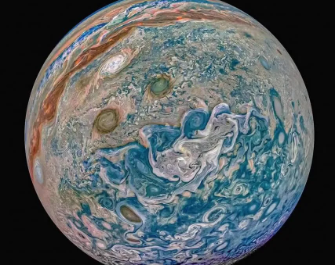
The blue is not a metaphor and it is not a coincidence of naming.
When scientists map magnetic polarity, they render it in false color — red for positive, blue for negative. The Great Blue Spot is a region of intense negative polarity. So when Jupiter’s magnetic field was drawn in full for the first time in human history, a deep blue spot appeared near the equator, as singular and as striking in that map as the Great Red Spot has been in visible light for four centuries.
The gas giant humanity had drawn in orange for four hundred years carried blue underneath.
And there is more than the color.
NASA’s own team says the Great Blue Spot works by magnetic field interacting with Jupiter’s deep atmospheric winds — winds that run over eighteen hundred miles down, to where the planet turns from gas into conductive liquid metal. And she said this: it is incredible that one narrow magnetic hot spot, the Great Blue Spot, could be responsible for almost all of Jupiter’s secular variation, but the numbers bear it out.
Now read what the film’s companion book said about Pandora. It was published in 2009, before the film came out, and quoted in the Christian Science Monitor that December.
The interaction of the magnetic fields of Pandora and its parent planet causes a giant increase in electrical activity on both bodies, with massive auroral storms and other electromagnetic phenomenon.
A film made in 2009 described magnetic flux interactions producing electromagnetic phenomena on a Jupiter-like gas giant.
Nine years later a spacecraft found exactly that, on Jupiter. And when they drew the map, it came out blue.
Now, somebody will tell you blue is just a convention. Scientists color negative polarity blue by choice, and a filmmaker picking blue is picking one of the most common colors there is.
Fine. Take the color away entirely.
You are still left with a man who, in 2009, described a gas giant whose magnetic field interacts with the world around it to produce electromagnetic effects nothing else produces. And nine years later, the instrument that could finally see inside Jupiter found one spot doing exactly that — singular, and responsible for nearly all the change in the planet’s field.
The blue is what catches your eye. The rest of it is what nobody can explain.
Now stop and think about what this would have required if he had worked it out by ordinary means.
He would have needed magnetic field data that did not exist. Juno did not launch until 2011, two years after the film came out. It did not reach Jupiter until 2016. The paper was not published until 2018. None of that data existed in 2009. It could not have existed. The instrument that collected it had not been built.
He would have needed to know that a planet observed in warm colors for four centuries would turn out to carry a singular blue anomaly at its equator. He would have needed its location. He would have needed to know what it does — that it drives electromagnetic effects the rest of the planet does not produce. He would have needed to know it would be one of a kind.
None of that was knowable. None of it had been measured. It did not exist in any laboratory, any database, any paper, or any conversation between any two human beings on this planet.
He could not have known.
And let us be honest about the man. James Cameron has never claimed to be anything but a filmmaker. He builds science fiction worlds for a living, and he had every commercial reason to render that planet in whatever color looked best on a screen.
So why blue?
Because the One who declares the end from the beginning put it there. Cameron did the work of a prophet and never knew he was doing it.
He did not know it was Christ giving him the creativity. He probably still does not. The audiences who called the film visually stunning saw a color and nothing else. The scientists who found the Great Blue Spot were not thinking about a movie.
But Christ knew. And now so do you.
Only Christ can do this. No human turned a planet blue.
No human can argue a human could have known.
There was no chain. No paper, no data, no conversation between 2009 and 2018 that could have carried it. Nothing to pass along, because there was nothing yet to know.
A man put it on a screen before it existed.
That is not luck and it is not a coincidence. That is Christ, declaring the end from the beginning, exactly as He said He would, so that we would know it was Him telling us.
I have even from the beginning declared it to thee; before it came to pass I shewed it thee: lest thou shouldest say, Mine idol hath done them.
— Isaiah 48:5 (KJV)And we missed it.
Once you see Jupiter, you see the rest of it.
Every other prediction I have shown could be waved off by a determined skeptic. Coincidence. Luck. Shadowy men passing notes to filmmakers. Statistical inevitability. The arguments are weak, but they exist.
Jupiter closes every one of them.
If He was behind Avatar, then He was behind the rest of them. The Simpsons did not name President Trump in the year 2000 by accident. The Lone Gunmen did not fly a plane into the Twin Towers six months early by accident. Contagion did not describe a bat-borne virus out of China by accident. 2001: A Space Odyssey did not put a tablet computer in a 1968 film by accident.
Now understand what that means, because this is where most people keep one foot out the door. They will grant you Jupiter — it is too exact, too clean, too impossible to deny. But they will try to isolate it. They will want Jupiter to be the one real case, with everything else dismissed as coincidence.
That door is already closed.
Jupiter is not the one case that worked. Jupiter is the one case no human hand could reach. No one plants a magnetic field inside a planet.
And one more thing about that film, because of when he made it.
Cameron wrote Avatar first. The treatment was on paper by the mid-nineties and he announced it would be his next picture after the one he was working on. Then the technology was not there — he wanted actors on screen who were not physically present, and the tools did not exist. So he put it in a drawer.
The picture he made instead was Titanic.
He did not make it from a distance either. He took a submersible down to the wreck and filmed the actual hull on the floor of the North Atlantic, two and a half miles down, and put that footage in the film.
Twelve years passed before he could make Avatar.
He spent them on the ship Morgan Robertson wrote fourteen years before it sank.
With Christ there are no coincidences.
He has been doing this the whole time. Through a Persian king who thanked the wrong god. Through a novelist who shrugged when they asked him how he knew. Through a filmmaker at the bottom of the Atlantic, waiting on technology that did not exist yet.
Hollywood was one channel. It was never the only one.
The same year the internet opened to the world, a card game was published.
What nobody has told you is Who is behind it.

Chapter Three — Sources
To verify any source below, copy the title and domain name and paste it into your search browser. Every claim in this chapter is documented and publicly available.
Comments
Share your thoughts, questions, or reflections on this chapter.
More of Interest
Keep exploring the signs — more from across the ministry.


"There was a very light, which lighteneth each man that cometh into this world" — John 1:9 · WYC 1382