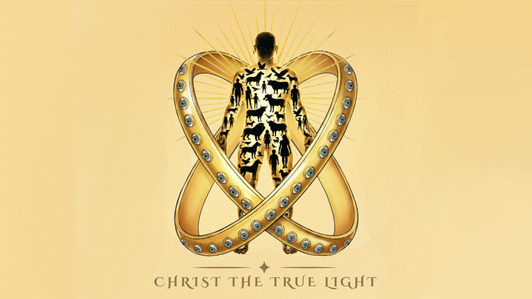
Wings on Wheels
“…the spirit of the living creatures was in the wheels.”
— Ezekiel 1:20 (NKJV)Now let us talk about something you see every day.
Car logos.
You pass them on every highway. In every parking lot. On every street. In every city in the world.
And yet — have you ever stopped to really look at them? Not glance. Look.
Have you ever noticed how many automotive brands use wings, wheels, and serpents in their logos?
Not one or two. Over a dozen.
These are billion-dollar corporations with logos that have been on the road for generations — and rooms full of designers who could change them any time and never do. Bentley’s wings, 1919. Alfa Romeo’s serpent, 1910. Aston Martin’s wings, 1927. A luxury brand launched in 2015 chose wings too.
Across every decade, every continent, every brand identity team, the same shape keeps surfacing.
Look at them.
Wings in Car Logos
.png)

Wheels, Circles & Serpents


Lagonda — wings swept back across the badge
Mazda — wings rising from the center
Morgan — wings flanking the crest
Mini — wings on the badge
SsangYong — wings on the emblem
These are not obscure brands. These are the most recognizable automotive names on the planet.
Bentley. Aston Martin. Chrysler. Audi. Alfa Romeo.
Wings. Wheels. A serpent consuming a man.
Not speed lines. Not gears. Not roads. The same cluster of images, independently arrived at, across different countries, different decades, different markets.
Now open your Bible to Ezekiel chapter 1.
Now as I looked at the living creatures, behold, a wheel was on the earth beside each living creature with its four faces… The appearance of their workings was, as it were, a wheel in the middle of a wheel… As for their rims, they were so high they were awesome; and their rims were full of eyes, all around the four of them.
— Ezekiel 1:15–18 (NKJV)…Wherever the spirit wanted to go, they went, because there the spirit went; and the wheels were lifted together with them, for the spirit of the living creatures was in the wheels.
— Ezekiel 1:20 (NKJV)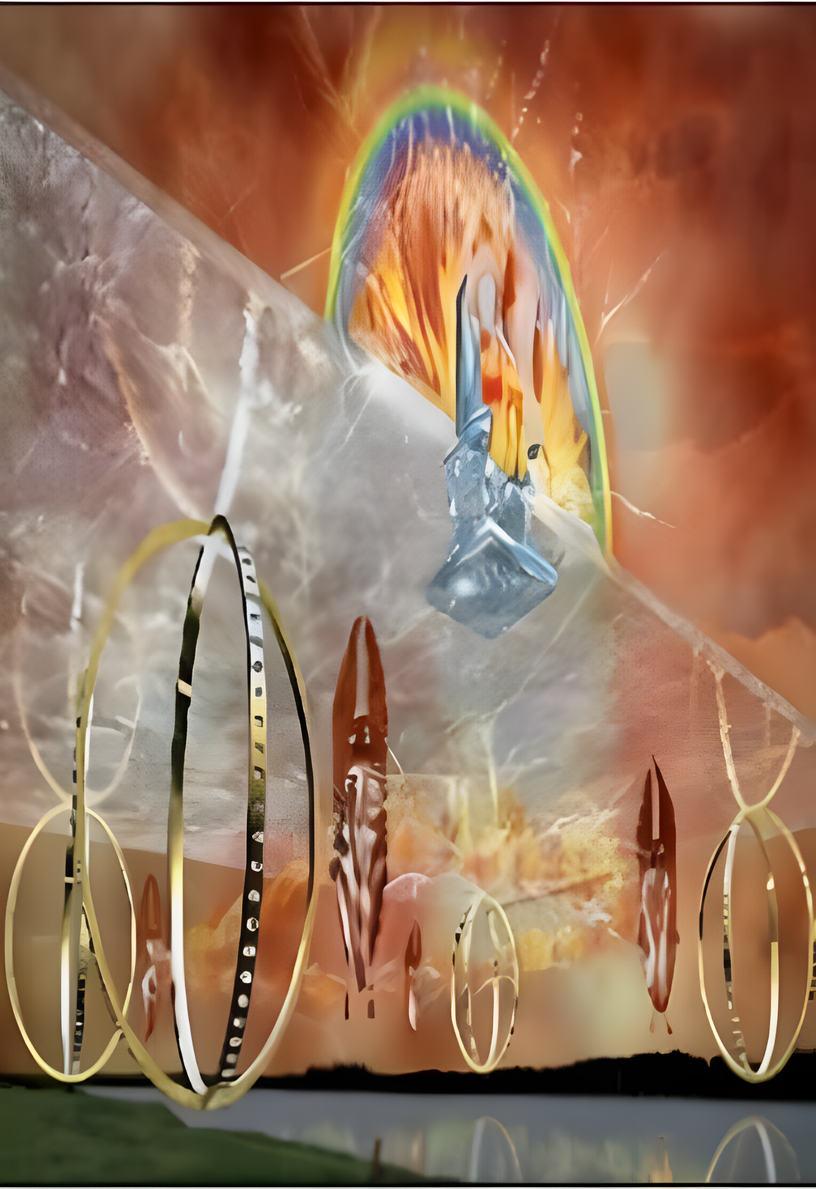
Read that carefully.
Wheels within wheels. Rims full of eyes — all-seeing, aware, watching. And when Ezekiel looks again in the tenth chapter, the eyes are not gathered in one place. They are everywhere, covering the whole of the living thing.
And their whole body, and their backs, and their hands, and their wings, and the wheels, were full of eyes round about, even the wheels that they four had.
— Ezekiel 10:12 (KJV)The body. The backs. The hands. The wings. Even the wheels. Every surface on them covered. Nothing on them blind. All-seeing. Alive.
This is the Illuminati.
The living ones beneath the throne, covered in eyes, every part of them seeing — that is the all-seeing eye.
And the Spirit of the living creatures was in the wheels.
— Ezekiel 10:17 (KJV)Not operating the wheels from a distance. In them. The wheels were not empty metal turning on an axle. They were alive. They moved because something lived inside them.
They had a Driver.
And I am not the first person to notice it.
The Hebrew word for these wheels is ʾōp̄ān — Strong’s H212. It is an ordinary word. It is the word for the wheels on Pharaoh’s chariots in the Red Sea. It is the word for the wheels on the bronze bases in Solomon’s temple. It is the word for the wheel on a threshing cart. There is nothing celestial in the word itself. It means wheel, the way you mean wheel.
And yet readers of this vision stopped treating them as ordinary wheels a very long time ago. They saw them as beings. Alive.
Before Jesus was born, Jewish scribes wrote a cycle of thirteen songs — one for each of the first thirteen Sabbaths of the year. They are called the Songs of the Sabbath Sacrifice, and they are also called the Angelic Liturgy, because that is what they describe: the worship going on in the heavenly temple, sung by the beings who live there.
The songs list the orders of that worship. And among the singers, named by name, are the ophanim. The wheels.
Not the wheels beneath the singers. Not the wheels that carry the throne the singers stand around. The wheels are listed among the ones singing.
That is the earliest surviving text where it happens.
Now here is the part that matters most. These songs were found among the Dead Sea Scrolls at Qumran, and a person could dismiss that — one desert community, one strange sect, one unusual reading. But a copy of the same text was also found at Masada, a hundred and eighty miles away.
And we know the two copies did not come from the same place. DNA testing of the parchment settled it. The copies found in the Qumran caves were written on the skins of closely related sheep — one flock, one source. The Masada copy came from a genetically different line of sheep. Nobody knows where those sheep were, and the researchers could not find out. What they could prove is that the scroll was not made at Qumran.
Two communities. Two separate scrolls. The same liturgy.
This was not fringe. This was not one group of separatists inventing something. This is how Jews read Ezekiel.
And those scribes were not the only ones who read the ophanim as alive.
The Book of Enoch places them in a circle of fire around the throne, and tells you what they do there.
And round about were Seraphim, Cherubim, and Ophannim: And these are they who sleep not and guard the throne of His glory.
— 1 Enoch 71:7 (Charles, 1917)They sleep not. They guard.
The second Book of Enoch calls them something else. He is taken into the seventh heaven and he sees them there, standing around the throne with the cherubim and the seraphim.
And the Cherubim and seraphim standing about the throne, the six-winged and many-eyed ones do not depart, standing before the Lord’s face doing his will, and cover his whole throne, singing with gentle voice.
— 2 Enoch 21:1 (Charles, 1917)The many-eyed ones. Covered in eyes, exactly as Ezekiel described them, and they do not depart.
Maimonides ranked them among the highest orders of angels in Jewish tradition. And Jewish writers gave them another name — galgalim, from a root meaning to roll, to whirl. That is the same word Daniel uses in Aramaic — galgal, Strong’s H1535 — when he sees the throne of the Ancient of Days with its wheels burning. It occurs one time in all of Scripture, and the lexicon that defines it calls what Daniel saw a throne-chariot.
Then centuries later, Christian writers went looking for a name for what Ezekiel saw. They found one in a list Paul wrote.
For by him were all things created, that are in heaven, and that are in earth, visible and invisible, whether they be thrones, or dominions, or principalities, or powers: all things were created by him, and for him.
— Colossians 1:16 (KJV)Four words in a row. Thrones, dominions, principalities, powers. Paul does not describe them. He does not say what they look like or where they stand. He names them and moves on, and the only thing he tells you about them is the thing he tells you about everything else in that sentence — that they were created by Him and for Him.
A Syrian writer in the fifth or sixth century took the first word off that list and gave it to the wheels.
Thrones.
And Jewish liturgy still names them, out loud, in synagogues, every weekday morning, in a prayer said before the Shema:
The ophanim and the holy living creatures raise themselves up, facing the seraphim they offer praise.
— Kedushah, Jewish Morning Liturgy
Raise themselves up.
Offer praise.
That is not what metal does.
So before I show you what I have been shown about what those wheels are and who is inside them, understand that I did not invent the idea that they are alive. That idea is older than the New Testament.
What I am going to tell you is not that the wheels are alive. That part has been settled. I am going to lift the veil off your face, so that when you look into the mirror you will see the glory of the Lord.
Nevertheless when one turns to the Lord, the veil is taken away. Now the Lord is the Spirit; and where the Spirit of the Lord is, there is liberty. But we all, with unveiled face, beholding as in a mirror the glory of the Lord, are being transformed into the same image from glory to glory, just as by the Spirit of the Lord.
— 2 Corinthians 3:16–18 (NKJV)The same glorious light Moses put a veil over his face to conceal.
Moses did not know that the skin of his face shone while he talked with Him. So when Aaron and all the children of Israel saw Moses, behold, the skin of his face shone, and they were afraid to come near him… And when Moses had finished speaking with them, he put a veil on his face.
— Exodus 34:29–30, 33 (NKJV)The same light Paul says He dwells in — unapproachable, where no man has seen Him and no man can. That is what filled the inner room, the Holy of Holies, behind the veil.
who alone has immortality, dwelling in unapproachable light, whom no man has seen or can see.
— 1 Timothy 6:16 (NKJV)Christ has been trying to show His people the location of this room. This book takes you to it.
Now — what does it mean that the Spirit of the living creatures was in the wheels?
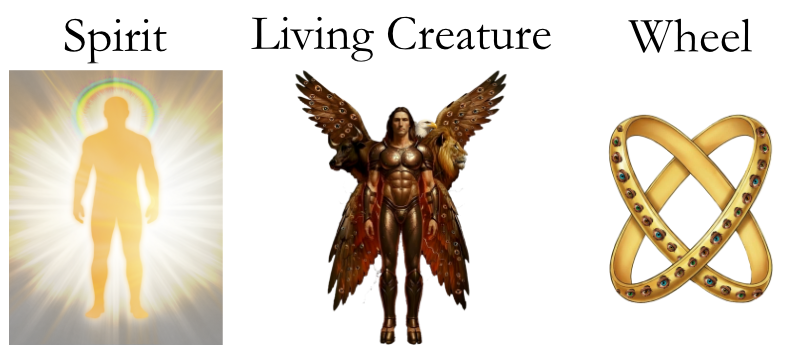
Wherever the spirit wanted to go, they went, because there the spirit went; and the wheels were lifted together with them, for the spirit of the living creatures was in the wheels.
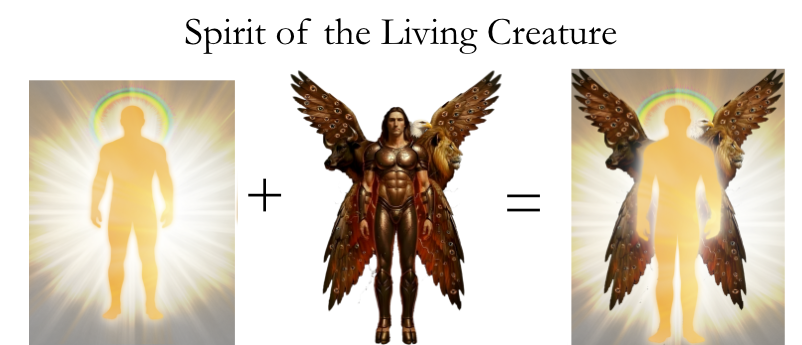
— Ezekiel 1:20 (NKJV)Look at what the verse actually says. The Spirit is of the living creatures. The Spirit is in the wheels. The whole architecture sits in those two small words.
Of. Not a Spirit that belongs to them the way a coat belongs to a man. A Spirit made up of them. One Spirit, and the living creatures are what it is made of.
They are not carrying Him. They are in Him.
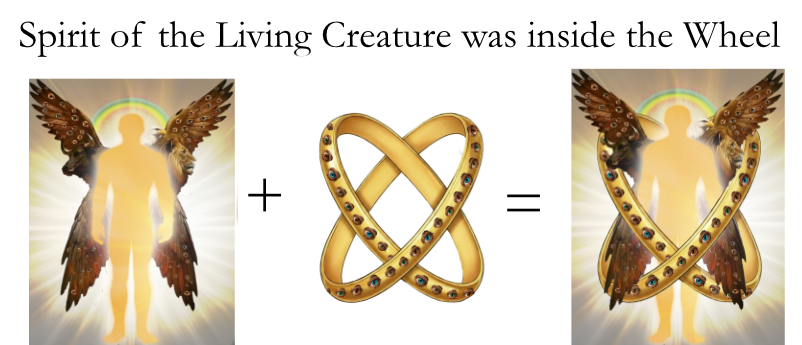
In. And that Spirit — the one made of all of them — is inside the wheel.
The wheel carries the Spirit.
So read the order again. The living creatures are in the Spirit. The Spirit is in the wheel.
One within another within another.
That is not something I added to the verse. It is sitting in the grammar.
The wheel is the outer vessel. Inside it is the Spirit. And the Spirit is made of the living ones themselves.
In him was life; and the life was the light of men.
— John 1:4 (KJV)That is why they go wherever He goes and stop wherever He stops. They have no motion of their own. They are members of Him. They make up His body.
Paul said it plainly.
For as the body is one, and hath many members, and all the members of that one body, being many, are one body: so also is Christ.
— 1 Corinthians 12:12 (KJV)Many members. One body. One Spirit, and all of them inside it at once. That is what Ezekiel was straining to show us six hundred years before Paul ever wrote it down — a body of many, moving as one, because they were all in the same Spirit. Ezekiel had no word for it. He saw it. He just could not say it. We can.
Now — some of you are already reaching for Paul to correct me. You have been taught what that verse means: the body of Christ is the living church, believers on earth, many members serving under one Head. Hold onto that. I am not here to take it from you. That reading is true, and this book will stand on it later.
But that is not all Paul was pointing at. He ends the sentence pointing at a different body, and the context word makes it plain — so also is Christ. That body is what Ezekiel saw.
There are places in this book where I will tell you plainly that something you have been taught is wrong. This is not one of them. What you were taught about the body of Christ is true. I am showing you a deeper truth underneath it, one the church does not understand. A truth I myself was given in a vision.
So I am telling you: the body of Christ is larger than the living. The many are not only the living gathered in worship. The many are also the gathered dead, moving as one, driving the wheels, because they are all in the same Spirit.
Thy kingdom come, Thy will be done in earth, as it is in heaven.
— Matthew 6:10 (KJV)A Kingdom on earth and a Kingdom in Heaven.
And here is how you know I am telling you the truth. I do not ask you to take my word for it. I do not ask you to take it on my vision alone. I let the Scriptures tell you — a habit I keep to consistently, because that is the only way I am going to convince you. Scripture itself will prove it.
The enemy cannot build without copying, and every copy points back to the original. So look at the counterfeit and read it in reverse.
Watch it prove itself.
The Body Larger Than the Living
Mark 5 shows us more than mainstream Christianity has ever taught. A man lived among the tombs, and when Jesus asked his name, the thing inside him answered.
My name is Legion: for we are many.
— Mark 5:9 (KJV)The counterfeit proves the original because it is built on the original. So look at Legion part for part, and watch it line up with Ezekiel’s wheels.
Ezekiel’s wheels were vessels. Bodies made to carry a spirit. The man among the tombs was the same thing.
He was the wheel. Something else was driving him. And that something was not one thing — it was many.
Ezekiel’s creatures had no motion of their own. They went where the Driver went, and stopped where He stopped. The man at the tombs had no motion of his own either.
For it had often seized him… and he was driven by the demon into the wilderness.
— Luke 8:29 (NKJV)Seized. Taken hold of by force. Driven — elaunō, G1643. The lexicon defines it in one line: to push, as wind, oars, or demonic power. Wind on a sail. A man at the oars. A demon in a body. One word for all three, because all three are the same thing — something outside a vessel, making it move. In this case the demon seized the man by force and literally drove him like a vehicle out into the wilderness, and left him living in the tombs.
When Jesus asked its name, the driver answered. The man’s lips moved, but he was not the one who spoke. This man was a wheel, and Legion was driving the vessel toward its own destruction.
Ezekiel’s wheel is driven by Christ — He indwells it, and the many He carries are gathered, carried, at rest in Him. This wheel is driven by Sin — he occupies the man, and the many he carries are the crowd that seized the seat.
Both drive. Both carry many. But one indwells what is His; the other occupies what he seized.
On one side the many are gathered and carried, living through us. On the other, the many Sin carries seize tabernacles to dwell in so that they too can live through us — but they do not belong there, because they were cut off.
…these bones are the whole house of Israel. They indeed say, “Our bones are dry, our hope is lost, and we ourselves are cut off!”
— Ezekiel 37:11 (NKJV)Same word. Opposite role. Same wheel, same seat, opposite Driver.
Ezekiel’s wheels and the man among the tombs are the same kind of thing. Both are vessels. Both are driven. The only question is who holds the reins — Christ, who indwells what is His, or Sin, who seizes what is not.
Now who exactly are the many, on both sides? Those many that make up the two spirits? Again — I will not ask you to take my word for it. I will show you from the text. But before I can tell you who they are, one thing has to be settled first, because the whole answer depends on it.
Isaiah saw the burning ones at the throne and called them seraphim. A hundred and forty-seven years later, Ezekiel saw the living creatures in the wheels and called them cherubim. Almost seven hundred years after that, John was shown the same throne room and called them living creatures.
Three names. The church has read them as three kinds of creature ever since.
They are not separate kinds of angel. Isaiah, Ezekiel, and John were all looking at the same beings. They just did not use the same word for them.
And they could not have. More than eight centuries separate the first vision from the last. Three men, three countries, two languages. Isaiah was dead five hundred years before John was born. They never met. They never compared notes. Nobody was there to hand them a common word.
So of course the names do not match. What matches is everything else. Watch how each prophet names them. Isaiah, at the throne, calls them śərāp̄îm — H8314 — literally the burning ones. In Ezekiel 1 they are the ḥayyôt — Strong’s H2416, the living ones. By chapter 10 he looks again and names the same beings kərûḇ, cherubim — H3742. One prophet, one set of creatures, two names. And John, shown the same throne, calls them zōa — G2226, the living creatures. The very word Ezekiel started with, now in Greek.
The proof is in John, who was shown the throne room and saw all of it at once.
He saw the glass, like crystal.
The likeness of the firmament above the heads of the living creatures was like the color of an awesome crystal, stretched out over their heads.
— Ezekiel 1:22 (NKJV)Before the throne there was a sea of glass, like crystal.
— Revelation 4:6 (NKJV)He saw Ezekiel’s four faces.
As for the likeness of their faces, each had the face of a man; each of the four had the face of a lion on the right side, each of the four had the face of an ox on the left side, and each of the four had the face of an eagle.
— Ezekiel 1:10 (NKJV)The first living creature was like a lion, the second living creature like a calf, the third living creature had a face like a man, and the fourth living creature was like a flying eagle.
— Revelation 4:7 (NKJV)He saw Isaiah’s six wings, and the beings he saw cried the very words Isaiah’s seraphim cried — Holy, holy, holy.
Above it stood seraphim; each one had six wings: with two he covered his face, with two he covered his feet, and with two he flew. And one cried to another and said: “Holy, holy, holy is the LORD of hosts; the whole earth is full of His glory!”
— Isaiah 6:2–3 (NKJV)The four living creatures, each having six wings, were full of eyes around and within. And they do not rest day or night, saying: “Holy, holy, holy, Lord God Almighty, who was and is and is to come!”
— Revelation 4:8 (NKJV)Ezekiel’s crystal and four faces. Isaiah’s six wings. Isaiah’s Holy, holy, holy. One vision. The cherubim in the wheels and the seraphim at the throne were never two things.
Four names across three prophets — burning ones, living ones, cherubim, living creatures — and one throne room holding them all. Not four kinds of being. One, seen from four angles.
And here is the thread that ties all of it — the wheels, the wings, the eyes, the burning ones — back to the hood of a car.
Go back to the logos. Wheels. Wings. A serpent. The three images the boardrooms keep reaching for are the three things Isaiah and Ezekiel and John saw around the throne. The wheels are the vessels the Spirit moves. The wings are the living creatures, seen in all three visions.
But what about the snake eating the man on the Alfa Romeo? The answer is simple. It ties to the man in Mark 5 with Legion living inside of him. That crowned serpent is the fiery serpent — śārāp̄, Strong’s H8314. The burning one. It is the same word Isaiah gives the seraphim at the throne.
Above it stood seraphim; each one had six wings: with two he covered his face, with two he covered his feet, and with two he flew.
— Isaiah 6:2 (NKJV)The word behind “seraphim” there is śərāp̄îm — the plural of śārāp̄. Same entry. H8314.
And the same word English hides in the wilderness as “fiery serpent.”
And the LORD sent fiery serpents among the people, and they bit the people…
— Numbers 21:6 (KJV)The word behind “fiery” is the same one. H8314.
English wrote “seraphim” at the throne and “fiery serpent” in the sand, and the reader never knew he was reading one creature twice.
One creature class. Some kept their place — the ones Ezekiel saw around the throne. The rest fell.
The thread is not over. Stay with me. If the fallen ones are packed into a wheel, what about the ones who did not fall — are they in wheels too?
This is the part the church has walked past for two thousand years.
Where do they come from?
They are human, but not only human. They are every living thing that ever breathed and died. That is why the faces are a man, a lion, an ox, an eagle — not a man alone.
Go back to Ezekiel. When he names the creatures in the wheels, the Hebrew is ḥayyôt — Strong’s H2416 — the living ones, the same root as the “living” in the “living soul” Christ breathed into Adam. And when he sees them a second time, he tells us plainly what they are.
This is the living creature I saw under the God of Israel by the River Chebar, and I knew they were cherubim.
— Ezekiel 10:20 (NKJV)The scholars call them throne guardians. They are. But no one asks the question underneath the title: who are they? Not a separate species invented to decorate a throne — the living. The ones who breathed the air of this world, who lived and died. Both the ones who made it, and the ones cut off.
Sit with that for a moment. The beings around the throne of God are not a separate order of creation. They once walked the earth, the way you do now.
The ones who made it were gathered home, into the body of the Spirit — into Christ — and now stand around the One they belong to. They are the redeemed. They are us: the living who made it.
And you do not have to take that from me. The living creatures say it themselves. When John hears them sing, this is the song.
And they sung a new song, saying, Thou art worthy to take the book, and to open the seals thereof: for thou wast slain, and hast redeemed us to God by thy blood, out of every kindred, and tongue, and people, and nation.
— Revelation 5:9 (KJV)Read who is singing. The four living creatures — the same four Ezekiel saw in the wheels — sing that Christ redeemed us. Not redeemed them. Us. The living creatures name themselves among the redeemed, gathered out of every kindred and tongue and people and nation. They are not a species that never fell and never needed saving. They are the saved. People, gathered out of the earth, by the blood.
The ones cut off were gathered too — into the body of Legion.
So the living creatures in Ezekiel’s wheels are not a separate order of angel.
They are the gathered dead — the many Christ carries.
The creatures in the wheels and the many He carries were never two things set side by side to compare. They are the same people, named twice.
And those people are not gone. Not asleep. Centuries after Moses died, he stood on a mountain — alive, awake, speaking with Jesus.
And behold, Moses and Elijah appeared to them, talking with Him.
— Matthew 17:3 (NKJV)Moses and Elijah standing there proves what I am saying, and it is enough.
The dead in Christ are alive, and present with Him. These two men died many years apart, yet here they are together, standing inside the light that was beaming through Jesus from inside his human flesh. The veil.
Remember, Christ is the Light. He is the True Light.
That is the weld the whole mirror hangs on. If the burning ones at the throne are people — the dead who entered into Christ, who make up His body — then the burning ones that fell are people too. Not a different species. The same kind, through the opposite door.
Same origin. Same death. Two different doors.
And they had names. That is what the church never says — that these were not nameless forces conjured out of nothing, but people who once had names and faces and a choice, who died cut off from Christ. It is why, when Jesus demanded a name among the tombs, the thing inside the man could answer with one. Legion. The name of a multitude, because a multitude of the lost is what it was. The dead who died separated from Christ.
Scripture never uses the Hebrew word for the Greek ones. Mark does not call Legion śārāp̄. He could not — he was writing in Greek, six hundred years and a language away from Isaiah.
But he calls them spirits. Unclean spirits. Ezekiel calls the ones at the throne spirits too.
One category. Two ends of it.
So Legion is not a separate kind of thing crammed into that man. It is the fallen ones, packed into a wheel and driving it to the sea. Legion’s many are not “like” the ones at the throne. They are the same kind. They are the ones who fell.
And you He made alive, who were dead in trespasses and sins, in which you once walked according to the course of this world, according to the prince of the power of the air, the spirit who now works in the sons of disobedience.
— Ephesians 2:1–2 (NKJV)Dead — and still walking. Walking according to the prince of the power of the air. The lost dead did not stop existing when they died in their sin. They went where their king reigns.
Combing the dry places for a house. That is the fallen many, hunting a vessel to seize.
So how does any of this relate to cars?
The Counterfeit Read in Reverse
Ask yourself the question no one in any boardroom will ask out loud. Wings. Wheels. A serpent consuming a man. Out of every possible symbol available to the human imagination, why do they arrive at the same ancient symbols a Mesopotamian artist would have carved four thousand years ago?
That is not a coincidence. That is not a trend.
Wheels are not modern shapes. The wheel is one of humanity’s oldest images of power, motion, and divine movement. Ancient civilizations carved wheels into temple walls thousands of years before Henry Ford ever drew a sketch.
Wings predate written language. Wings have always meant the same thing across every culture that ever recorded the divine — transcendence. Movement beyond the physical. Carrying. Lifting. Bearing into another realm.
So why put them on a car? Because wings carry. And a car carries. The designers reached for the oldest symbol of being carried and bolted it to the thing built to carry you. They were more right than they knew.
And that is not so strange as it sounds. Take a kitten from its mother the day it is born and raise it alone, and it will still sit down and wash itself. Nobody taught it. Hatch a bird in an incubator with no nest in sight, and when it is grown it will build one — the same shape its kind has always built. Move a monarch butterfly to a place it has never been, and it will still fly toward Mexico. None of them were shown. It is in them.
Men are the same way. A designer sits down to draw a badge and reaches for a wing, and he could not tell you why. Something in him knows what a wing means. He is not remembering. He is carrying.
But the wing is not the only ancient image riding the hood. Look again at the Alfa Romeo. Not the wing. The serpent.
The Biscione did not come from Babylon. It came from medieval Italy — from the Visconti of Milan, who placed it on their crest in the eleventh century.
Eight hundred years later a brand-new car company, founded in that same city, reached back for its oldest emblem. They have kept it on their cars since 1910.
The Visconti did not know what they were declaring. Alfa Romeo’s designers did not know either. But the image rolled into the modern world anyway — a serpent consuming a man — and now sits on every Alfa Romeo on the highway. The Architect placed it in their hands, just as He placed the snake on the pole. The humans only displayed it.
Three ancient images, each carrying a meaning the modern designer no longer remembers — and the serpent eating the man is the oldest of them. It is what has been devouring us since Eden. The ones made from the dust of the ground.
And the LORD God formed man of the dust of the ground, and breathed into his nostrils the breath of life; and man became a living soul.
— Genesis 2:7 (KJV)And the LORD God said unto the serpent… upon thy belly shalt thou go, and dust shalt thou eat all the days of thy life.
— Genesis 3:14 (KJV)Dust shalt thou eat. The man is made of dust — and dust is what the serpent eats. Not a sentence passed on him. A description of him. He devours the dust-formed man. The serpent eating the man is not a symbol someone invented for a car badge. It is what Eden already told us the serpent is, carved onto the hood four thousand years later.
They are not choosing these symbols. The symbols are choosing them. The Architect placed them in the human imagination at the beginning, and He has been surfacing them through every civilization since — one Spirit, wearing whatever name each age gave Him, moving the same images through every hand that ever held a chisel, most of them never knowing whose hand was guiding theirs. He is surfacing them still. In boardrooms, on the hoods of cars, on the highway. On hospital walls. On the doctor’s coat. On the side of the ambulance. He preached it from temple walls and cathedral carvings, and now He preaches it from the hood of a car.
The world has never noticed.
This is how He proves He exists. Not in a sign across the sky. In the symbols He has surfaced through human hands for six thousand years, in plain sight the whole time. The proof has never been hidden. We have been too blind to see it.
The spiritually blind see a car logo. The spiritually awake see a pattern. Wheels and wings where Ezekiel saw the wheel. A serpent eating a man where Moses lifted the bronze.
A pattern that stretches back thousands of years. A pattern rolling down the highway beside you every morning on your way to work.
Hidden in plain sight.
You Have Driven Past This Your Whole Life
That is why Christ points at the caduceus. At the biscione. At the wings. He is not pointing at the designer’s intent. He is pointing at what was true before the designer was born. The symbols were already His. The counterfeit only borrowed them.
Every one of these companies is filled with people. Designers, engineers, executives. Christ is in every one of them and has hidden His signature in plain sight — in logos, in branding, in the machines we drive to work.
The wings on the badge. The serpent devouring the man. They have been on the road the whole time.
You have driven past this your whole life.
Do you see it?
The Sovereign Witness
I can already hear the objection. Wings just symbolize speed. It is just marketing.
Fine. Let us follow that logic. Why do wings mean speed? Who embedded that association so deeply into human consciousness that designers reach for it instinctively? It did not come from nowhere. Something planted it so deep in the human imagination that it keeps surfacing — in ancient temples, in Scripture, and on the hood of a car rolling off an assembly line.
The designers did not sit down and study Ezekiel to arrive at these images. They did not need a theology degree to choose these shapes. The symbols were already in them, placed there by the One who gives breath and spirit to all who walk the earth.
I have filled him with the Spirit of God in wisdom, in understanding, in knowledge, and in all kinds of craftsmanship, to make artistic designs…
— Exodus 31:3–4 (NKJV)Christ said this about Bezalel — the craftsman He appointed to build the tabernacle. But the principle did not retire with Bezalel. He lights every man who comes into the world. He is the source of every creative impulse, every design instinct, every artistic gift, whether the person holding the pencil knows His name or not.
This is not a new pattern. Christ has always worked through human hands that had no idea who was guiding them. He worked through a pagan king named Cyrus — a king who had never worshipped Him — and used him to free Israel.
I need you to hold on to that for a bit.
But if He can do that through a king who never worshipped Him, He can do it through a designer who never opened a Bible.
The creators think they are inventing. But they are actually echoing. His fingerprints are on everything. They are tuned into a frequency they do not understand. Transmitting messages from the only One who exists outside of time.
for bi the greetnesse of fairnesse and of creature the creatour of these thingis myyte be seyn knowyngli.
— Wisdom of Solomon 13:5 (Wycliffe, Grapevine 2024)for by the greatness of fairness and of (the) creature(s) the Creator of these might be seen knowingly, either might be known by his works.
— Wisdom of Solomon 13:5 (Wycliffe Modern Version, Noble 2001)The Driver and the Vehicle
Think about what a car actually is. A vehicle. A vessel. A body of metal and glass. It sits there — motionless, lifeless, going nowhere. Until a driver gets in. The moment a driver takes the seat, everything changes. The vehicle has purpose. Direction. Movement. Life.
The wheels did not move themselves. The Spirit moved them.
You are the vehicle. There is a Driver for the vessel.
That is the design. That is what the automotive industry has been testifying to for over a century without knowing it. They put wings on the logos because these vehicles were meant to represent a journey beyond the physical.
And if you still cannot grasp it as spiritual fact, He is so good about doing this. He proves Himself. With Christ there are no coincidences.
The newest model with wings?
Genesis. Open your eyes.

Genesis launched as its own brand in 2015 — born in our lifetime, rising right now.
Look at the emblem. Wings. Look at the name. Genesis. The beginning.
The first book of the Bible. The place where Christ created. Where He breathed life into man. Where the serpent first took a bite. Where the whole story started.
The world calls it branding. But the name and the wings together tell the story of the Beginning, whether they knew what they were echoing or not.
He has been preaching from the parking lot the whole time. They think they are selling a car. But what they are really doing is displaying a parable.
The Serpent on the Hood
Go back to Chapter One.
Christ sent the physical serpents so Israel could see what had already bitten them. The snakes in the wilderness were His teaching tool. His way of putting the serpent on display so His people could finally perceive what had been destroying them all along.
Now look at the Alfa Romeo logo. A serpent. Wearing a crown. Consuming a man.
The serpent on the hood is not just a generic serpent. He is the one — the śārāp̄, lifted up by Christ in the wilderness, now on a different pole. A hood. In a different millennium. For the same purpose.
Moses lifted him on the pole. So the bitten could finally see.
That image has been on their cars since 1910. Over a century. Two world wars. The moon landing. The smartphone in every pocket. Through all of it, that serpent has been rolling down the highway. Past hospitals. Past schools. Past churches. In front of billions of human eyes for over a century — and the world looked at it and called it a logo.
That is a lesson that has been running for a hundred years.
With every student absent.
Christ does not hide His teaching tools. He puts the serpent on the pole. He puts the serpent on the hood. He puts the serpent on the hospital wall. He put it there so you would see him. So you would recognize him. So that every time that logo rolls past you, something in your spirit would stir and say: there he is. The one who has been devouring humanity since the beginning. The one whose bite is already in us.
Christ put the snake there so we would understand what has been devouring us. The Driver within the wheel.
Every commute. Every school run. Every trip to the grocery store. The logos were right there — on the car in front of you, on the truck in the next lane, on the dealership you pass every Tuesday.
Wings. Wheels. A serpent consuming a man.
You saw them. You just did not perceive them.
That is not an insult. That is exactly what Christ said would happen when He spoke these words through Jesus.
Seeing you will see and not perceive.
— Matthew 13:14 (NKJV)The signs were never hidden. They were never buried in some ancient text only scholars could access. They were on the highway. In the parking lot. In your own driveway. Right in front of you the whole time.
This is how Christ proves His existence in a tangible way. Not in a church. Not behind a pulpit. On the highway. On the hood of a car rolling past you at sixty miles an hour.
And the whole world drove past them — every single day — without once asking why those images felt so right to the people who designed them.
Take Him out of the box, because you now know what He is capable of.
That means car logos and a hospital mascot are not the only place we can find His signature. I have two more for you.
The same pattern that shows up in corporate boardrooms has been playing out on cinema screens for decades. Hollywood has been showing us events before they happened — specific disasters, specific symbols, specific moments in history — years, sometimes decades, before they occurred.
Someone has been narrating this story from outside of time. Dropping clues into the culture. Leaving fingerprints on the films, the logos, the cards, the headlines.
You have driven past this your whole life. Now turn the page and watch Him do it on a screen.

Your progress is saved automatically and syncs with the book index.
Chapter Two — Sources
To verify any source below, copy the title and domain name and paste it into your search browser. Every claim in this chapter is documented and publicly available.
Comments
Share your thoughts, questions, or reflections on this chapter.